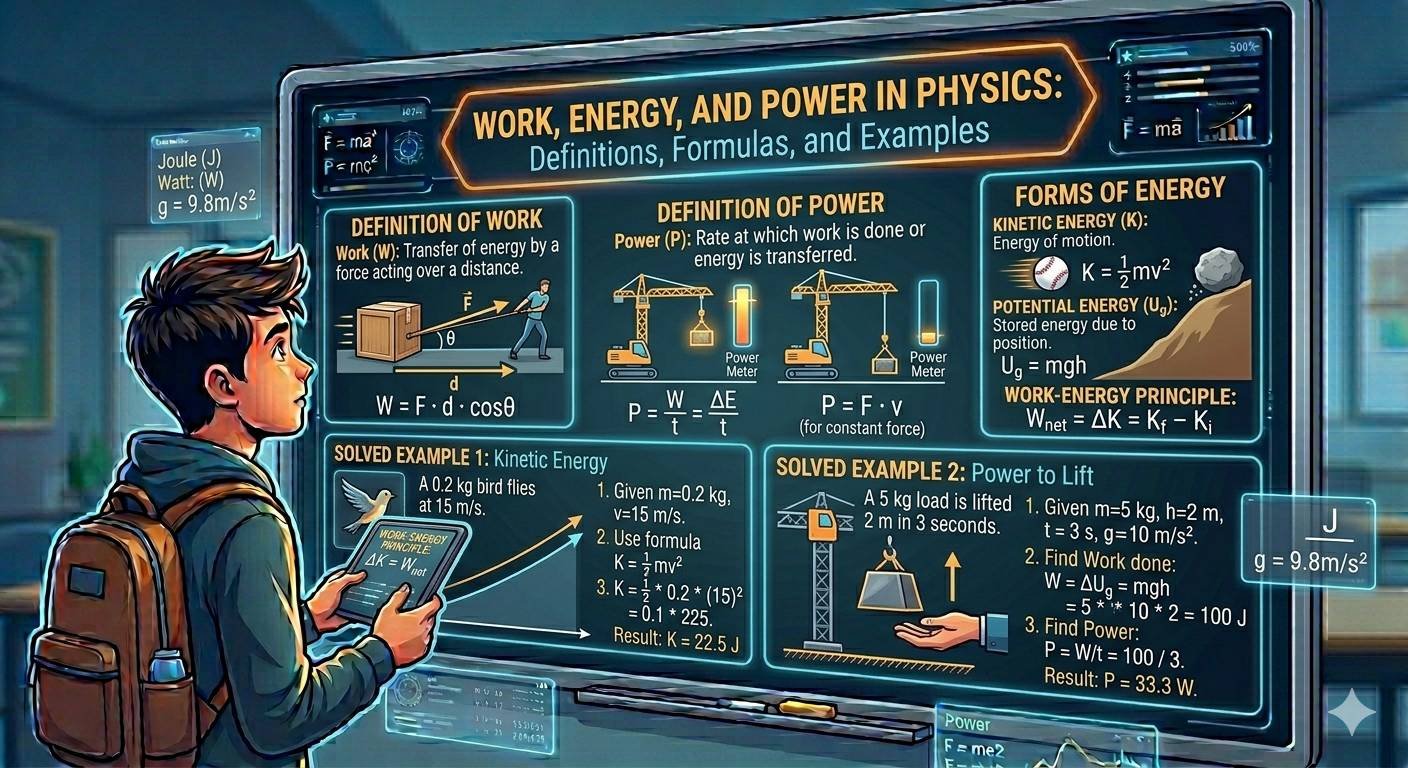
Work in physics is the energy transferred to an object when a force moves it through a distance. Holding a heavy suitcase while standing still is exhausting — but in physics, it counts as exactly zero work. No displacement means no work, no matter how hard you strain.
This article covers the precise physics definitions of work, kinetic energy, potential energy, conservation of energy, and power — concepts that explain everything from roller coasters to hydroelectric dams.
Table of Contents
What Is Work in Physics? (Not What You Think)
Work is done when a force causes an object to move through a distance. If there is no movement, there is no work — regardless of how much effort you feel.
Three conditions must all be met:
- A force must act on the object.
- The object must be displaced (move some distance).
- The force must have a component in the direction of the displacement.
Holding a bag of groceries overhead? Force exists (you push up), but displacement is zero. Zero work. Carrying the bag horizontally at constant height? Force is upward, displacement is horizontal — they are perpendicular. Zero work. Lifting the bag from the floor to the shelf? Force is upward, displacement is upward — same direction. That is work.
This “surprise” — that holding something heavy is zero physics work — is the hook that makes students pay attention. Physics work is about energy transfer, not muscular effort.
Work Formula: W = Fd cos θ
W = Fd cos θ
- W = work done (in joules, J)
- F = magnitude of the applied force (in N)
- d = displacement (in m)
- θ = angle between the force and the direction of displacement
When force and displacement point in the same direction (θ = 0°): W = Fd. Maximum work.
When force is perpendicular to displacement (θ = 90°): W = 0. No work.
When force opposes displacement (θ = 180°): W = −Fd. Negative work (force takes energy away). Friction does negative work on a sliding object because friction opposes the motion.
Units: 1 joule = 1 newton × 1 meter = 1 N·m = 1 kg·m²/s².
Kinetic Energy — The Energy of Motion
Kinetic energy is the energy an object has because it is moving.
KE = ½mv²
- m = mass (kg)
- v = speed (m/s)
A 1000 kg car moving at 20 m/s has KE = ½ × 1000 × 20² = 200,000 J = 200 kJ.
Double the speed and kinetic energy quadruples (because v is squared). This is why highway crashes are so much more dangerous than parking-lot bumps — at 60 km/h, a car has four times the kinetic energy it has at 30 km/h.
Kinetic energy is a scalar — it has no direction. A ball moving left at 5 m/s and a ball moving right at 5 m/s have exactly the same kinetic energy.
Potential Energy — Stored Energy Waiting to Act
Potential energy is energy stored because of an object’s position or configuration.
Gravitational Potential Energy: PE = mgh
- m = mass (kg)
- g = 9.8 m/s²
- h = height above a chosen reference point (m)
A 5 kg book on a 2 m shelf has PE = 5 × 9.8 × 2 = 98 J relative to the floor. That stored energy converts to kinetic energy if the book falls.
Elastic Potential Energy: PE = ½kx²
- k = spring constant (N/m)
- x = compression or extension distance (m)
A stretched bow, a compressed spring, and a bent diving board all store elastic potential energy. Release them, and that energy converts to kinetic energy (the arrow flies, the toy launches, the diver goes airborne).
Gravitational potential energy connects deeply to Newton’s law of gravitation — the formula PE = mgh is actually a simplified version of the general gravitational PE formula for objects near Earth’s surface.
The Work-Energy Theorem
The work-energy theorem states that the net work done on an object equals the change in its kinetic energy.
W_net = ΔKE = ½mv₂² − ½mv₁²
If you push a box from rest to 5 m/s, the net work you did equals the kinetic energy gained. If friction slows a sliding box from 8 m/s to 3 m/s, the negative work done by friction equals the kinetic energy lost.
This theorem is powerful because it connects forces (through work) directly to speed changes, without needing to calculate acceleration or time. It is especially useful for problems where the force varies along the path.
Conservation of Energy — The Most Powerful Law in Physics
Energy cannot be created or destroyed — it can only be transformed from one form to another. The total energy of an isolated system remains constant.
KE₁ + PE₁ = KE₂ + PE₂ (when no non-conservative forces act)
This is the conservation of mechanical energy. A roller coaster demonstrates it perfectly.
At the top of the first hill: maximum PE, minimal KE (the car is nearly stationary). As the car descends: PE converts to KE (it speeds up). At the bottom: minimal PE, maximum KE (fastest speed). Going up the next hill: KE converts back to PE (it slows down).
If there is no friction, the car could reach exactly the same height as the first hill. In reality, friction converts some mechanical energy to heat, so each successive hill must be lower.
📌 Common Misconception: “Energy gets used up.”
Energy is never used up. It changes form. A car “burns” fuel — the chemical energy in gasoline converts to kinetic energy (motion), thermal energy (heat), and sound energy. The total energy is conserved; it just spreads into forms that are less useful. This connects to the second law of thermodynamics — energy tends to disperse.
Conservative vs. non-conservative forces: Gravity and springs are conservative forces — the work they do depends only on the start and end positions, not the path. Friction is non-conservative — the work it does depends on the path (longer path = more energy lost to heat). When non-conservative forces act, you modify the equation:
KE₁ + PE₁ + W_non-conservative = KE₂ + PE₂
Power — How Fast Work Gets Done
Power measures the rate at which work is done or energy is transferred.
P = W/t = Fv
- P = power (in watts, W)
- W = work done (in joules)
- t = time taken (in seconds)
- F = force, v = velocity (the alternative form)
Units: 1 watt = 1 joule per second. Named after James Watt, the steam engine pioneer.
A person climbing stairs does the same work whether they walk or sprint — but sprinting requires more power because the same work is done in less time.
Power comparisons to build intuition:
- Human resting metabolism: ~80 W
- Human walking: ~75 W of mechanical power
- Human sprinting: ~2000 W (briefly)
- Car engine: ~150,000 W (200 horsepower)
- Lightning bolt: ~10¹² W (a trillion watts, for a fraction of a second)
🌍 Real-World Connection: Horsepower (hp) is an older unit of power. 1 hp = 746 W. James Watt defined it to help sell his steam engines — he estimated a horse could lift 33,000 pounds one foot per minute, and marketed his engines in terms of “how many horses they could replace.”
Solved Examples on Work, Energy, and Power
Problem 1: Work Done at an Angle
A 10 kg box is pushed 5 m across a floor with a 50 N force applied at 30° above the horizontal. Find the work done by the applied force.
W = Fd cos θ = 50 × 5 × cos 30° = 50 × 5 × 0.866 = 216.5 J
Note: only the horizontal component of the force (F cos 30°) does work in the direction of displacement. The vertical component lifts slightly, reducing the normal force but not contributing to horizontal work.
Problem 2: Roller Coaster Energy Conservation
A 500 kg roller coaster car starts from rest at 30 m height. Find speed at the bottom (a) with no friction, and (b) with 10% energy lost to friction.
(a) No friction: PE₁ = KE₂ → mgh = ½mv² → v = √(2gh) = √(2 × 9.8 × 30) = √588 = 24.2 m/s
(Notice mass cancels — speed at the bottom is independent of mass.)
(b) With 10% energy loss: 90% of PE converts to KE: 0.9 × mgh = ½mv² v = √(2 × 0.9 × 9.8 × 30) = √529.2 = 23.0 m/s
Friction reduces the speed by about 1.2 m/s — a relatively small effect for 10% energy loss, because velocity goes as the square root of energy.
Problem 3: Power Output Running Up Stairs
A 60 kg person runs up 10 m of stairs in 8 seconds. Find the power output.
Work done against gravity: W = mgh = 60 × 9.8 × 10 = 5880 J Power: P = W/t = 5880/8 = 735 W (about 1 horsepower)
This is a substantial power output — sustainable only briefly. Marathon runners average about 75-100 W of mechanical power.
Energy in Everyday Life — Where Physics Meets Reality
Energy transformations are everywhere once you know where to look.
Hydroelectric dam: Gravitational PE of water at height converts to KE as water falls, then to electrical energy via turbines.
Bow and arrow: Elastic PE (stored in the bent bow) converts to KE (the flying arrow).
Braking a car: KE of the moving car converts to thermal energy (heat in the brake pads) through friction. This is why brakes get hot during hard stops.
Pendulum: KE at the bottom ↔ PE at the sides. The total mechanical energy stays constant (approximately — air resistance slowly removes energy).
Eating food: Chemical PE in food converts to thermal energy (body heat) and KE (muscle movement). Your body is an energy conversion machine.
Try your own calculations with the Work & Energy Calculator.
Frequently Asked Questions
What is work in physics?
Work is the energy transferred when a force moves an object through a distance. The formula is W = Fd cos θ, where F is force, d is displacement, and θ is the angle between them. If there is no displacement, or if the force is perpendicular to displacement, no work is done.
What is the work energy theorem?
The work-energy theorem states that the net work done on an object equals the change in its kinetic energy: W_net = ΔKE = ½mv₂² − ½mv₁². It connects forces directly to speed changes without needing to calculate time or acceleration.
What is the difference between kinetic and potential energy?
Kinetic energy is the energy of motion (KE = ½mv²). An object has it because it is moving. Potential energy is stored energy due to position or configuration (gravitational PE = mgh, elastic PE = ½kx²). Potential energy can convert to kinetic energy and vice versa.
What is conservation of energy?
Conservation of energy states that energy cannot be created or destroyed — only transformed from one form to another. The total energy of an isolated system stays constant. A roller coaster converts PE to KE and back. A falling ball converts PE to KE. The total never changes.
What is the formula for power in physics?
Power is P = W/t (work divided by time) or equivalently P = Fv (force times velocity). It measures how fast energy is transferred. The unit is the watt (W), equal to one joule per second.
Can energy be created or destroyed?
No. This is the law of conservation of energy, one of the most fundamental laws in all of physics. Energy can change form — kinetic to thermal, chemical to electrical, potential to kinetic — but the total amount never increases or decreases. This law has never been violated in any experiment.