
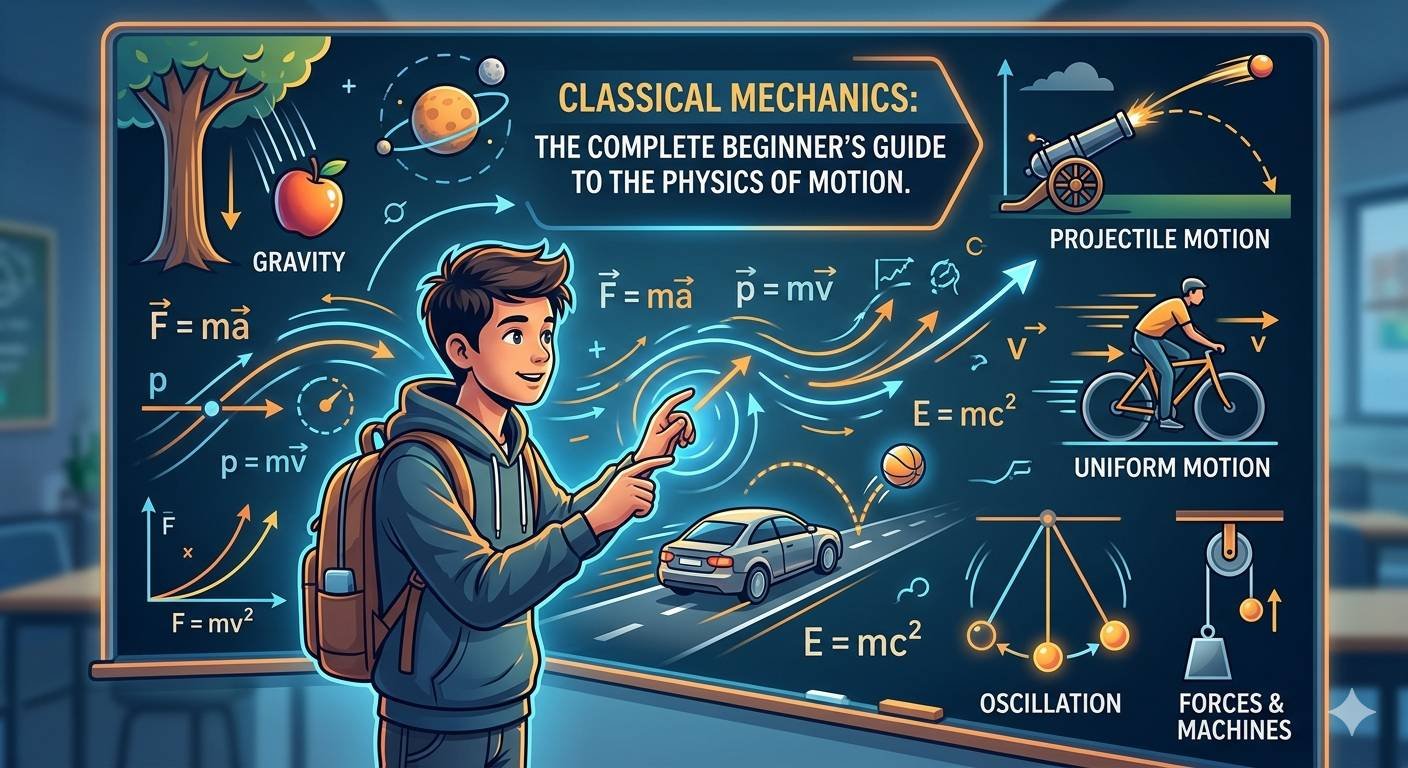
Classical mechanics is the branch of physics that describes the motion of objects using Newton’s laws. It accurately predicts the behavior of everything from falling balls to orbiting satellites — and it forms the foundation of nearly all engineering on Earth.
If you have ever caught a ball, driven a car, or watched a rocket launch, you have witnessed classical mechanics in action. This guide walks you through every core concept — from forces and friction to energy and momentum — so you can understand (and solve) the physics of the everyday world.
Table of Contents
What Is Classical Mechanics?
Classical mechanics is the study of how and why objects move. It uses a small set of laws — primarily those developed by Isaac Newton in the late 1600s — to predict the motion of everything from a sliding book to an orbiting planet.
The field covers two main branches. Kinematics describes how objects move — their position, velocity, and acceleration over time. Dynamics explains why they move — the forces that cause acceleration.
Classical mechanics works brilliantly for objects that are much larger than atoms and much slower than the speed of light. A baseball, a car, a bridge, a planet — all obey classical mechanics with extraordinary precision.
📌 Common Misconception: Many students think classical mechanics is “outdated” because quantum mechanics and relativity exist. In reality, classical mechanics remains the primary tool for almost every engineering discipline on Earth. NASA uses it to plan spacecraft trajectories. Civil engineers use it to design bridges. Sports scientists use it to optimize athletic performance.
A Brief History
The story starts with Galileo Galilei in the early 1600s. Galileo challenged the ancient Greek view (held by Aristotle) that heavier objects fall faster and that motion requires a constant push. Through careful experiments with inclined planes, Galileo showed that all objects accelerate at the same rate under gravity — and that objects in motion tend to stay in motion.
Isaac Newton built on Galileo’s work and published his masterpiece, Principia Mathematica, in 1687. In it, Newton stated three laws of motion and a law of universal gravitation that together form the backbone of classical mechanics. Leonhard Euler later formalized much of the mathematics, and Johannes Kepler’s earlier laws of planetary motion found their explanation through Newton’s gravity equation.
🌍 Real-World Connection: Every time a structural engineer calculates whether a building can withstand wind load, they use classical mechanics. The equations are the same ones Newton wrote over 300 years ago.
Newton’s Laws of Motion — The Foundation of Everything
Newton’s three laws of motion are the core rules that govern how forces affect objects. Every problem in classical mechanics starts here.
The First Law (Law of Inertia): An object stays at rest or keeps moving at constant velocity unless a net external force acts on it. This means motion itself does not need a cause — changes in motion do. A hockey puck on ice keeps sliding until friction (an external force) slows it down. For a deep exploration with experiments you can try at home, see our Newton’s First Law (Inertia) guide.
The Second Law (F = ma): The net force on an object equals its mass times its acceleration. Push harder, it accelerates more. Make the object heavier, it accelerates less for the same force. This single equation — F = ma — is the most-used equation in all of physics. We break down every detail, with worked examples, in our Newton’s Second Law (F = ma) article.
The Third Law (Action-Reaction): For every force one object exerts on another, the second object exerts an equal and opposite force back. When you push a wall, the wall pushes you. When a rocket blasts exhaust downward, the exhaust pushes the rocket upward. Learn why these pairs never cancel out in our Newton’s Third Law guide.
📌 Common Misconception: Students often think the Third Law means “forces cancel out.” They do not — because the two forces act on different objects. The force of your foot on the ground and the ground’s force on your foot are a Third-Law pair, but they act on different things (your foot vs. the ground), so they do not cancel.
Force, Mass, and Acceleration (F = ma)
Force equals mass times acceleration. This is the equation that lets you predict the motion of anything.
F = ma
- F = net force (in newtons, N) — the total of all forces acting on the object
- m = mass (in kilograms, kg) — how much matter the object contains
- a = acceleration (in meters per second squared, m/s²) — how quickly velocity changes
Think of pushing a shopping cart. An empty cart accelerates easily with a gentle push. A cart loaded with groceries needs a much bigger push to accelerate at the same rate. That is F = ma in action.
Quick Example: A 5 kg box is pushed with a net force of 20 N. What is its acceleration?
a = F / m = 20 N / 5 kg = 4 m/s²
The box accelerates at 4 meters per second every second. Simple as that.
The force in F = ma must be the net force — the total of all forces combined. If you push a box with 20 N to the right and friction pushes 5 N to the left, the net force is 15 N to the right. This is why free body diagrams are so critical — they help you identify every force before you calculate. Try quick calculations with our F = ma Calculator.
Projectile Motion — How Objects Fly
Projectile motion describes the curved path of an object launched into the air and affected only by gravity. The key insight is that horizontal and vertical motions are completely independent.
A ball thrown horizontally from a cliff keeps its horizontal speed constant (no horizontal force, ignoring air resistance). At the same time, it accelerates downward at g = 9.8 m/s² due to gravity. The combination produces a parabolic trajectory.
Core Equations:
- Horizontal position: x = v₀ cos θ · t
- Vertical position: y = v₀ sin θ · t − ½gt²
- Range (level ground): R = v₀² sin 2θ / g
The maximum range on level ground occurs at a 45° launch angle. Galileo Galilei was the first to study this systematically, showing that the horizontal and vertical components of motion can be analyzed separately.
🌍 Real-World Connection: Sports analysts use projectile motion equations to optimize basketball free throws, soccer kicks, and javelin throws. The optimal launch angle for a javelin is actually less than 45° because the release height differs from the landing height.
📌 Common Misconception: Many students believe that a heavier ball falls faster or lands sooner when thrown. In projectile motion (without air resistance), mass does not affect the trajectory at all. A bowling ball and a tennis ball launched at the same speed and angle follow the same path.
For the full set of formulas, five worked examples, and a step-by-step solving method, visit our Projectile Motion complete guide. You can also plug in your own numbers with our Projectile Motion Calculator.
Friction — Why Things Stop Moving
Friction is the force that resists the sliding or rolling of one surface over another. Without friction, you could not walk, drive, or even pick up a glass.
There are two main types for solid surfaces. Static friction keeps an object from starting to move — it matches the applied force up to a maximum value. Kinetic friction acts on an object that is already sliding — it has a constant value that is always less than the maximum static friction.
The Formula:
- Static: f_s ≤ μ_s · N (an inequality — static friction adjusts)
- Kinetic: f_k = μ_k · N (a constant value once sliding)
Here, μ is the coefficient of friction (a number between 0 and 1 for most surfaces), and N is the normal force pressing the surfaces together.
📌 Common Misconception: “Friction always opposes motion.” More precisely, friction opposes relative motion between surfaces. When you walk, static friction pushes your foot forward — it is the force that propels you. Without friction, your foot would slide backward and you would go nowhere.
Quick Example: A 10 kg box sits on a floor with μ_s = 0.5. The normal force is N = mg = 10 × 9.8 = 98 N. The maximum static friction is f_s = 0.5 × 98 = 49 N. You need to push harder than 49 N to get it moving.
Friction has enormous engineering importance. Tire tread patterns, brake pad materials, and non-slip shoe soles are all designed around friction coefficients. Read the full guide with a coefficient table and solved problems in our Friction in Physics article. Crunch your own numbers with the Friction Calculator.
Energy, Work, and Power
Work in physics has a very specific meaning: it is the energy transferred to an object when a force moves it through a distance.
W = Fd cos θ
- W = work done (in joules, J)
- F = applied force
- d = displacement
- θ = angle between force and displacement
Holding a heavy suitcase while standing still? That is zero work in physics — because there is no displacement. Carrying it horizontally? Still zero work — because the force (upward, against gravity) is perpendicular to the displacement (horizontal).
Kinetic energy is the energy of motion: KE = ½mv². Potential energy is stored energy due to position: PE = mgh (gravitational) or PE = ½kx² (elastic spring).
The conservation of energy states that energy cannot be created or destroyed — only transformed from one form to another. A roller coaster at the top of a hill has maximum potential energy. As it descends, that PE converts to kinetic energy (speed). At the bottom, KE is at its maximum. This principle connects directly to thermodynamics — the first law of thermodynamics is essentially conservation of energy applied to heat systems.
Power measures how fast work is done: P = W/t. A person who runs up stairs in 5 seconds exerts more power than one who walks up in 30 seconds — even though the total work is identical.
For formulas, the work-energy theorem, and three solved problems, see our Work, Energy, and Power guide. Use the Work & Energy Calculator for quick answers.
Momentum and Collisions
Momentum is mass in motion. Any moving object has momentum, and the heavier or faster it moves, the more momentum it carries.
p = mv
- p = momentum (in kg·m/s)
- m = mass
- v = velocity
The conservation of momentum says that in an isolated system (no external forces), the total momentum before an event equals the total momentum after. This is the master rule for analyzing collisions.
In an elastic collision, both momentum and kinetic energy are conserved. Billiard balls come close to this. In a perfectly inelastic collision, the objects stick together, momentum is conserved, but kinetic energy is not — some converts to heat and deformation. Car crashes are inelastic collisions.
Momentum is directly related to Newton’s Second Law. In fact, F = ma is really a simplified version of F = dp/dt — the rate of change of momentum. When mass is constant, dp/dt reduces to ma. But for variable-mass systems like rockets (which lose mass as they burn fuel), the full momentum form is essential.
🌍 Real-World Connection: Car crumple zones, airbags, and seatbelts all use the impulse-momentum theorem (J = FΔt = Δp). By increasing the collision time (Δt), they reduce the force on passengers. A longer, gentler stop is far less lethal than a sudden one.
Explore elastic vs. inelastic collisions with worked problems in our Conservation of Momentum article. Try the Momentum & Collision Simulator.
Circular Motion and Centripetal Force
Any object moving in a circle is constantly accelerating — even if its speed never changes. That is because acceleration measures changes in velocity, and velocity includes direction. A car turning a corner changes direction, so it accelerates.
Centripetal acceleration: a_c = v²/r
Centripetal force: F_c = mv²/r
Centripetal force is not a new type of force. It is simply the label for whatever force points toward the center of the circle. For a satellite in orbit, gravity provides the centripetal force. For a car turning, friction between tires and road provides it. For a ball on a string, tension provides it.
📌 Common Misconception: “Centrifugal force pushes you outward when a car turns.” There is no outward push. Your body wants to continue in a straight line (inertia, Newton’s First Law), and the car door pushes you inward (centripetal force). You feel pushed outward, but that is your body resisting the inward turn.
Full coverage with the loop-the-loop analysis, minimum speed formulas, and three solved examples is in our Circular Motion and Centripetal Force article.
Gravity — From Falling Apples to Orbiting Planets
Newton’s law of universal gravitation states that every mass attracts every other mass with a force proportional to both masses and inversely proportional to the square of the distance between them.
F = Gm₁m₂ / r²
- G = 6.674 × 10⁻¹¹ N·m²/kg² (universal gravitational constant)
- m₁, m₂ = the two masses
- r = distance between their centers
This single equation explains why apples fall, why the Moon orbits Earth, and why galaxies hold together. The familiar g = 9.8 m/s² is simply what you get when you plug in Earth’s mass and radius: g = GM/R².
Henry Cavendish first measured G in 1798 using a delicate torsion balance — effectively “weighing the Earth.”
📌 Common Misconception: “There is no gravity in space.” The International Space Station orbits at an altitude where gravity is about 90% as strong as on the surface. Astronauts float because they are in free fall — the station and everyone inside are falling toward Earth together, creating the sensation of weightlessness.
Dive into orbital velocity, escape velocity, weight on other planets, and solved problems in our Newton’s Law of Gravitation guide.
Torque and Rotational Motion
Torque is the rotational equivalent of force. While force causes linear acceleration, torque causes angular acceleration — it makes things spin.
τ = rF sin θ
- τ = torque (in N·m)
- r = distance from the pivot (lever arm)
- F = applied force
- θ = angle between the force and the lever arm
Open a door by pushing near the hinge — it barely moves. Push at the handle (far from the hinge) — it swings easily. Same force, different torque. The lever arm matters enormously.
The rotational analog of F = ma is τ = Iα, where I is the moment of inertia (resistance to angular acceleration) and α is angular acceleration. Just as a heavier object needs more force to accelerate linearly, an object with a larger moment of inertia needs more torque to spin.
🌍 Real-World Connection: Tightrope walkers carry long poles to increase their moment of inertia. A large I means any wobble produces only a small angular acceleration, giving the walker time to correct their balance.
Learn the door experiment, the seesaw problem, and the full torque-force analogy table in our Torque and Rotational Motion article.
How to Solve Classical Mechanics Problems (Step-by-Step)
Every mechanics problem follows the same general approach. Master this method and you can solve almost anything.
Step 1: Draw a free body diagram. Isolate the object. Draw every force acting on it as an arrow — gravity, normal force, friction, tension, applied forces. Never draw “ma” as a force. Acceleration is the result, not a cause.
Step 2: Choose coordinate axes. For flat surfaces, use horizontal and vertical. For inclined planes, tilt your axes so one is parallel to the surface and one is perpendicular. This simplifies the math dramatically.
Step 3: Apply Newton’s Second Law along each axis. Write ΣF_x = ma_x and ΣF_y = ma_y. Plug in every force component.
Step 4: Solve the equations. You might have one equation and one unknown (simple) or a system of equations with two unknowns (use substitution or elimination).
Step 5: Check your answer. Does the direction make sense? Are the units correct? Is the magnitude reasonable?
This five-step method works for blocks on tables, cars on hills, objects in orbit, and collisions. The situations change — the method does not.
Classical Mechanics vs Modern Physics — Where Newton Breaks Down
Newton’s laws work spectacularly well — until they do not. There are two situations where classical mechanics fails.
Very fast objects (near the speed of light): At everyday speeds, Newton’s laws are perfect. But as an object approaches 3 × 10⁸ m/s (the speed of light), relativistic effects become significant. Mass appears to increase, time dilates, and lengths contract. Einstein’s special relativity (1905) replaces Newton’s mechanics at these extreme speeds.
Very small objects (atomic scale): Electrons, protons, and photons do not behave like baseballs. They exhibit wave-particle duality, exist in probability clouds, and obey the uncertainty principle. Quantum mechanics governs this domain.
For everything in between — which includes virtually all of engineering, sports, transportation, architecture, and planetary science — classical mechanics remains the gold standard. You can explore what happens beyond Newton in our Modern Physics pillar page.
Summary: Key Concepts at a Glance
| Concept | Key Formula | SI Unit | Common Application |
|---|---|---|---|
| Force | F = ma | Newton (N) | Pushing, pulling, structural loads |
| Momentum | p = mv | kg·m/s | Collisions, car safety |
| Work | W = Fd cos θ | Joule (J) | Lifting, machines |
| Kinetic Energy | KE = ½mv² | Joule (J) | Moving vehicles, sports |
| Potential Energy | PE = mgh | Joule (J) | Dams, roller coasters |
| Power | P = W/t | Watt (W) | Engines, motors |
| Torque | τ = rF sin θ | N·m | Wrenches, doors, engines |
| Gravitational Force | F = Gm₁m₂/r² | Newton (N) | Orbits, tides, weight |
| Centripetal Force | F = mv²/r | Newton (N) | Curves, orbits, spinning |
| Friction | f = μN | Newton (N) | Braking, walking, tires |
Frequently Asked Questions About Classical Mechanics
What is classical mechanics in simple terms?
Classical mechanics is the branch of physics that explains how objects move and what forces cause that motion. It covers everything you can see and touch in daily life — from a ball rolling on the ground to a satellite orbiting Earth — using laws first described by Isaac Newton.
What are the 3 laws of classical mechanics?
The three laws are Newton’s laws of motion. The First Law says objects stay at rest or in constant motion unless acted on by a force. The Second Law says force equals mass times acceleration (F = ma). The Third Law says every action force has an equal and opposite reaction force.
What is the difference between classical mechanics and quantum mechanics?
Classical mechanics describes the motion of large, everyday objects (cars, planets, balls) and works at normal speeds. Quantum mechanics describes the behavior of extremely small particles (electrons, photons, atoms) where classical rules break down. Classical mechanics is a subset that works perfectly in the everyday world.
Who is the father of classical mechanics?
Isaac Newton is widely regarded as the father of classical mechanics. His 1687 book Principia Mathematica laid out the three laws of motion and the law of universal gravitation, which together form the complete foundation of the field. Galileo Galilei is considered the father of the experimental method that made Newton’s work possible.
What are examples of classical mechanics in everyday life?
Classical mechanics explains why seatbelts protect you in a crash (inertia), how a basketball arcs through the air (projectile motion), why you lean when a car turns (centripetal force), how brakes stop a car (friction), and why bridges hold weight without collapsing (equilibrium of forces and torques).
Is classical mechanics still used today?
Absolutely. Classical mechanics is the foundation of civil engineering, mechanical engineering, aerospace engineering, robotics, sports science, vehicle design, and architectural design. NASA uses Newtonian mechanics for most spacecraft trajectory calculations. It remains the most widely applied branch of physics in the modern world.