
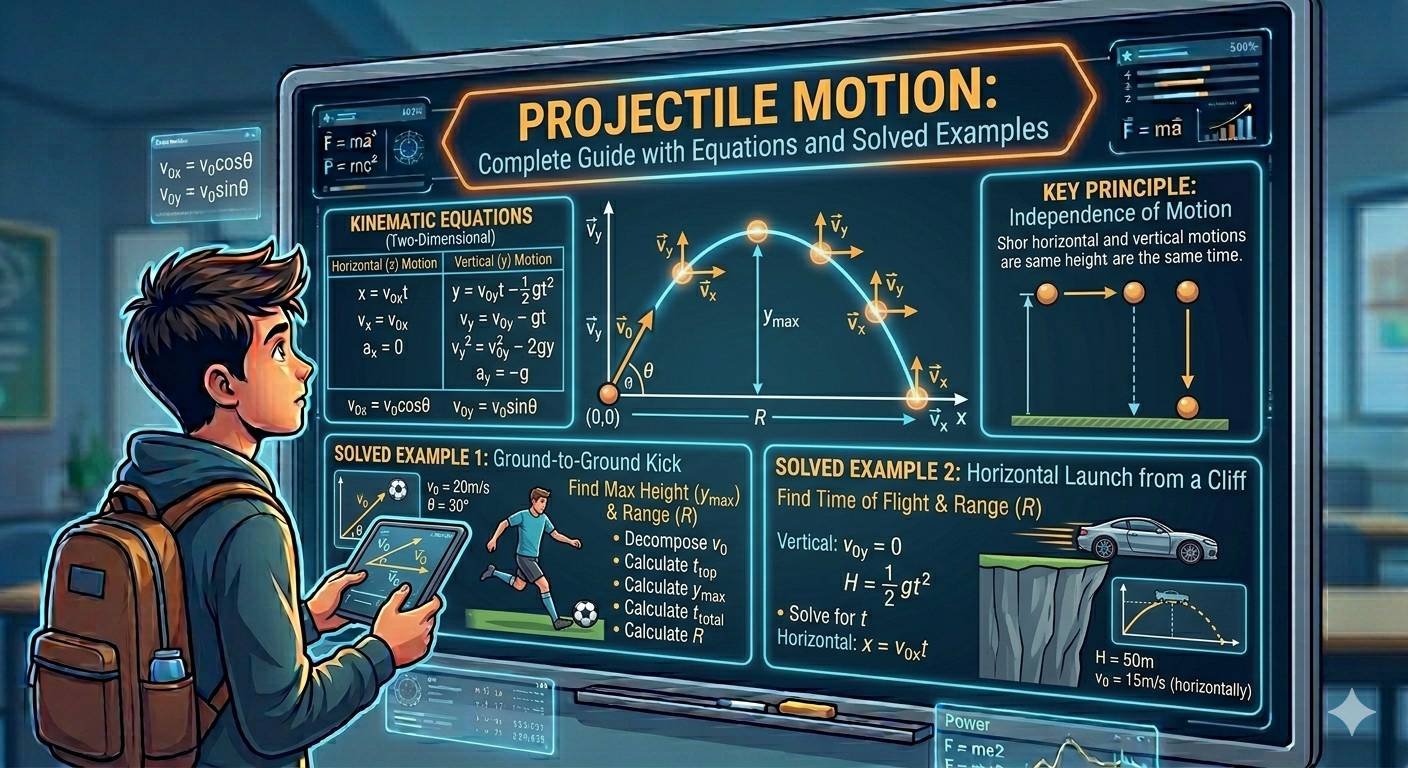
Projectile motion is the curved path an object follows when launched into the air and acted upon only by gravity. The trajectory is always a parabola (when air resistance is ignored), and the key to solving any projectile problem is treating horizontal and vertical motion as completely independent.
Whether you are analyzing a basketball shot, a kicked football, or a cannonball, the physics is identical. This guide gives you every equation, the step-by-step solving method, and five fully worked examples.
Table of Contents
What Is Projectile Motion?
A projectile is any object that has been launched or thrown and then moves under the influence of gravity alone. Once it leaves the launcher — hand, bat, cannon, whatever — no engine or push drives it forward. Gravity is the only force acting on it (ignoring air resistance).
Galileo Galilei was the first to systematically study projectile motion in the early 1600s. He discovered that the path is a parabola and that the horizontal and vertical components of motion behave independently. This was a breakthrough — before Galileo, nobody understood why cannonballs followed curved paths.
The Key Principle: Horizontal and Vertical Motion Are Independent
This is the single most important idea in all of projectile motion. Memorize it. Internalize it.
Horizontal motion and vertical motion do not affect each other.
Horizontally, the projectile moves at a constant velocity (no horizontal force, so no horizontal acceleration). Vertically, the projectile accelerates downward at g = 9.8 m/s² due to gravity.
Here is the thought experiment that proves it: Stand at the edge of a cliff. Hold two identical balls at the same height. Drop one straight down. At the exact same instant, throw the other one horizontally. Which one hits the ground first?
They hit at the same time. The horizontal throw does not delay the fall. The vertical motion (falling under gravity) is completely unaffected by the horizontal motion (moving sideways). The thrown ball simply lands farther from the cliff.
🧪 Try This: Walk at a constant pace and toss a ball straight up. It lands back in your hand — even though you kept walking. Why? Because the ball has the same horizontal velocity as you, and its horizontal motion continues unchanged while it goes up and comes down. This is independence of horizontal and vertical motion in action.
Projectile Motion Equations (All Formulas You Need)
For a projectile launched at angle θ with initial speed v₀:
Horizontal (constant velocity):
- x = v₀ cos θ · t
- v_x = v₀ cos θ (constant throughout)
Vertical (constant acceleration g downward):
- y = v₀ sin θ · t − ½gt²
- v_y = v₀ sin θ − gt
Where:
- v₀ = initial speed (m/s)
- θ = launch angle above horizontal
- g = 9.8 m/s² (acceleration due to gravity)
- t = time elapsed (s)
- x, y = horizontal and vertical positions
These equations come directly from the basic kinematics equations, with a_x = 0 (no horizontal acceleration) and a_y = −g (constant downward acceleration).
Time of Flight, Maximum Height, and Range
Three headline quantities that define a projectile’s trajectory (assuming launch and landing at the same height):
Time of Flight: T = 2v₀ sin θ / g
This is the total time from launch to landing. The projectile spends equal time going up and coming down.
Maximum Height: H = v₀² sin² θ / (2g)
The highest point occurs at t = T/2, when the vertical velocity momentarily equals zero.
Range (horizontal distance): R = v₀² sin 2θ / g
The total horizontal distance covered from launch to landing.
Each formula tells a physical story. The range formula, for example, shows that range depends on v₀² (doubling the speed quadruples the range) and on sin 2θ (the angle matters too).
Why 45 Degrees Gives Maximum Range
The range formula is R = v₀² sin 2θ / g. The function sin 2θ reaches its maximum value of 1 when 2θ = 90°, which means θ = 45°.
At 45°, the launch splits the initial velocity equally between horizontal and vertical components. Too steep (say 80°) and the projectile goes very high but not far. Too shallow (say 10°) and it goes fast horizontally but barely gets off the ground.
But this only works on level ground. If you launch from a height (like a cliff or a basketball player’s release point), the optimal angle drops below 45°. If you launch uphill, the optimal angle shifts. The simple “45° = max range” rule is a special case, not a universal truth.
🌍 Real-World Connection: Shot putters release the ball from about 2 meters above ground, and the optimal angle is around 42°. Long jumpers take off at about 20-22° because their horizontal speed is far greater than their vertical speed — a completely different optimization from the simple formula.
Projectile Motion at an Angle — Step-by-Step Method
Every projectile problem follows this method:
Step 1: Break the initial velocity into components.
- v₀ₓ = v₀ cos θ (horizontal)
- v₀ᵧ = v₀ sin θ (vertical)
Step 2: Use vertical equations to find time. Usually, you find when the projectile reaches a certain height (the ground, maximum height, etc.).
Step 3: Use horizontal equation (x = v₀ₓ · t) with that time to find horizontal distance.
Step 4: If needed, find the velocity at any point using v_x and v_y components.
The method is the same whether the launch angle is 30°, 60°, or any other value.
Projectile Motion from a Height (Horizontal Launch)
A special case: an object launched horizontally from a height (θ = 0°).
Here, v₀ₓ = v₀ (all speed is horizontal) and v₀ᵧ = 0 (no initial vertical speed). The object starts falling immediately due to gravity.
Horizontal: x = v₀ · t Vertical: y = ½gt² (falling from rest vertically)
Time to hit ground (from height h): t = √(2h/g) Horizontal range: x = v₀ · √(2h/g)
This applies to objects kicked off cliffs, balls rolling off tables, and packages dropped from aircraft.
Solved Examples (5 Problems, Increasing Difficulty)
Problem 1: Ball Thrown Horizontally from a Cliff
A ball is thrown horizontally at 15 m/s from a 20 m cliff. Find (a) time to hit the ground and (b) how far from the base it lands.
(a) Vertical: 20 = ½(9.8)t² → t² = 40/9.8 = 4.08 → t = 2.02 s
(b) Horizontal: x = 15 × 2.02 = 30.3 m from the base.
Problem 2: Ball Launched at 30°
A ball is launched at 30° with initial speed 20 m/s. Find range, max height, and time of flight.
Components: v₀ₓ = 20 cos 30° = 17.3 m/s, v₀ᵧ = 20 sin 30° = 10 m/s.
Time of flight: T = 2(10)/9.8 = 2.04 s
Max height: H = 10² / (2 × 9.8) = 5.10 m
Range: R = 17.3 × 2.04 = 35.3 m
Problem 3: Maximizing Range vs. Maximizing Height
At what angle should you kick a football for maximum range? For maximum height?
Maximum range: θ = 45° (sin 2θ is maximized). Maximum height: θ = 90° (straight up, sin²θ is maximized). But the range would be zero — the ball goes straight up and comes straight down.
In practice, you balance range and height based on the specific goal.
Problem 4: Finding Initial Speed from Range
A ball launched at 60° lands 100 m away on level ground. What was the initial speed?
R = v₀² sin 2θ / g → 100 = v₀² sin 120° / 9.8 → 100 = v₀² × 0.866 / 9.8
v₀² = 100 × 9.8 / 0.866 = 1131.6 → v₀ = 33.6 m/s
Problem 5: Projectile from a Tower (Advanced)
A projectile is launched from a 50 m tower at 45° with speed 30 m/s. Find where it lands.
Components: v₀ₓ = 30 cos 45° = 21.2 m/s, v₀ᵧ = 30 sin 45° = 21.2 m/s.
Vertical equation (taking ground as y = 0 and launch point as y = 50): 0 = 50 + 21.2t − ½(9.8)t² 4.9t² − 21.2t − 50 = 0
Using the quadratic formula: t = [21.2 + √(449.4 + 980)] / 9.8 = [21.2 + √1429.4] / 9.8 = [21.2 + 37.8] / 9.8 = 6.02 s (taking the positive root).
Horizontal distance: x = 21.2 × 6.02 = 127.6 m from the base of the tower.
Use the Projectile Motion Calculator to verify your own problems.
Common Mistakes in Projectile Motion Problems
📌 Mistake 1: Using the full initial velocity instead of components.
If v₀ = 20 m/s at 30°, the horizontal speed is not 20 m/s — it is 20 cos 30° = 17.3 m/s. Always decompose first.
📌 Mistake 2: Forgetting that horizontal acceleration is zero.
There is no horizontal force (ignoring air resistance), so v_x stays constant throughout the flight. Students sometimes apply g in the horizontal direction — never do this.
Mistake 3: Ignoring the launch height. The range formula R = v₀² sin 2θ / g only works when launch and landing are at the same height. If they are different (off a cliff, off a table), you must use the full equations.
Mention on air resistance: Real projectiles do not follow perfect parabolas. Air resistance slows them down, reduces range, and makes the trajectory asymmetric (the descending arc is steeper than the ascending arc). This is why golf balls have dimples — the dimples create a thin turbulent boundary layer that actually reduces drag, allowing the ball to travel farther.
Projectile motion connects to Newton’s Second Law (F = ma) (gravity provides the force), gravitational force, and energy conservation (KE and PE trade off throughout the flight).
All concepts link back to the Classical Mechanics.
Frequently Asked Questions
What is projectile motion in physics?
Projectile motion is the motion of an object that has been launched into the air and moves under the influence of gravity alone. The path is a parabola. The horizontal and vertical motions are independent — horizontal velocity stays constant while vertical velocity increases due to gravity.
What are the 3 types of projectile motion?
The three types are horizontal launch (object thrown sideways from a height), angular launch (launched at an angle from the ground), and vertical launch (thrown straight up). All follow the same principles — only the initial conditions differ.
What is the formula for range in projectile motion?
For level ground: R = v₀² sin 2θ / g, where v₀ is initial speed, θ is launch angle, and g = 9.8 m/s². Maximum range occurs at θ = 45°. If launch and landing heights differ, you must use the full kinematic equations instead.
Why is 45 degrees the best angle for projectile motion?
The range formula contains sin 2θ, which is maximized when 2θ = 90° (i.e., θ = 45°). At 45°, the initial velocity is split equally between horizontal speed (carrying it far) and vertical speed (keeping it in the air long). This balance only gives maximum range on level ground.
Does mass affect projectile motion?
No (ignoring air resistance). A heavy ball and a light ball launched at the same speed and angle follow identical paths. Gravity accelerates all objects equally at g = 9.8 m/s², regardless of mass. In real conditions, air resistance affects lighter objects more, but the underlying physics is mass-independent.
What is the difference between projectile motion and free fall?
Free fall is a special case of projectile motion where the horizontal velocity is zero. The object falls straight down (or is thrown straight up). In general projectile motion, the object has both horizontal and vertical velocity, creating a curved path. Both involve only gravitational acceleration.