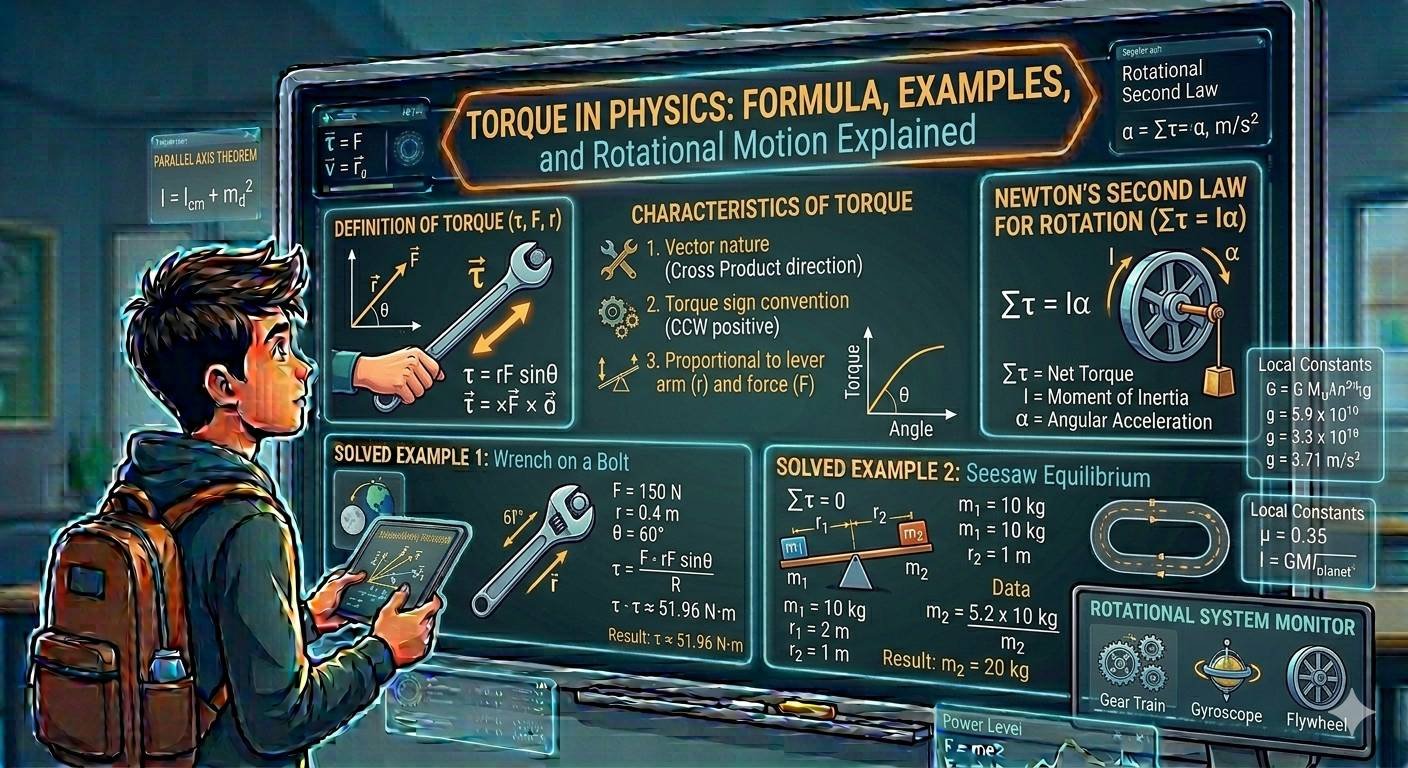
Torque is the rotational equivalent of force — it is what makes things spin, turn, and rotate. While a force causes linear acceleration, torque causes angular acceleration.
If you have ever opened a door, tightened a bolt, or ridden a bicycle, you have applied torque. The key insight is that torque depends not just on how hard you push, but where and at what angle you push.
Table of Contents
What Is Torque?
Torque is a twisting force that causes rotation around an axis or pivot point. Just as a force changes linear motion (Newton’s Second Law: F = ma), torque changes rotational motion.
The word “torque” comes from the Latin torquere, meaning “to twist.” In some textbooks (especially British ones), torque is called “moment of force” or simply “moment.”
Torque is a vector quantity. It has magnitude (how strong the twist is) and direction (which way it makes the object rotate — clockwise or counterclockwise).
Torque Formula (τ = rF sin θ)
τ = rF sin θ
- τ (tau) = torque (in newton-meters, N·m)
- r = distance from the pivot point to where the force is applied (the lever arm)
- F = magnitude of the applied force
- θ = angle between the force direction and the lever arm
When the force is perpendicular to the lever arm (θ = 90°): τ = rF. Maximum torque.
When the force is parallel to the lever arm (θ = 0° or 180°): τ = 0. No torque at all — the force pushes directly toward or away from the pivot without any twisting.
When the force is applied at the pivot itself (r = 0): τ = 0. No lever arm means no twist.
Why the Lever Arm Matters
The door experiment: Try opening a heavy door by pushing near the hinge. It barely moves. Now push at the handle, far from the hinge. It swings easily.
Same force. Same door. Different torque.
Pushing near the hinge gives a small r, so the torque (τ = rF) is small. Pushing at the handle gives a large r, so the torque is large. This is why door handles are placed as far from the hinge as possible — to maximize your torque with minimal effort.
The wrench principle: A longer wrench gives more torque on a stubborn bolt. Mechanics use long-handled wrenches (breaker bars) to loosen tight bolts. The extra length increases r, which increases torque without requiring more force.
Archimedes understood this principle deeply. He reportedly said, “Give me a lever long enough and a fulcrum on which to place it, and I shall move the world.” He was talking about torque.
Torque vs Force — What’s the Difference?
Force causes linear acceleration (straight-line motion). Torque causes angular acceleration (rotational motion).
Force is measured in newtons (N). Torque is measured in newton-meters (N·m).
Important: The unit N·m for torque looks identical to the unit for energy (joule = N·m). But they are NOT the same thing. Torque is a vector (it has direction — clockwise or counterclockwise). Energy is a scalar (no direction). You should never write torque in joules or energy in N·m. The identical dimensions are a coincidence of the unit system.
📌 Common Misconception: “Torque and energy have the same units, so they are the same thing.”
Wrong. Torque (N·m) is a rotational force with direction. Energy (J = N·m) is a scalar quantity. They have the same dimensions by coincidence, but they represent completely different physical concepts. Always write torque in N·m and energy in J.
Rotational Equilibrium (When Torques Balance)
An object is in rotational equilibrium when the net torque on it is zero.
Στ = 0
This means the total clockwise torque equals the total counterclockwise torque. The object does not start rotating (or, if already rotating, continues at constant angular velocity).
A balanced seesaw is the classic example. A heavy child close to the pivot can balance a lighter child far from the pivot — because torque depends on both force (weight) and distance.
This principle is used constantly in engineering. A bridge must be designed so that all torques from loads and supports cancel out, preventing rotation (collapse).
Moment of Inertia — The Rotational Mass
Moment of inertia (I) is to rotation what mass is to linear motion. It measures how much an object resists angular acceleration.
A heavy, spread-out object (like a large wheel) has a high moment of inertia — it is hard to start spinning and hard to stop. A small, compact object (like a spinning top) has a low moment of inertia — it spins up quickly.
The moment of inertia depends not just on the total mass, but on how that mass is distributed relative to the rotation axis. Mass far from the axis contributes more to I than mass near the axis.
🌍 Real-World Connection: Tightrope walkers carry long, heavy poles. The pole increases the walker’s moment of inertia. A large I means that any destabilizing torque (from a wobble) produces only a small angular acceleration (τ = Iα → α = τ/I). The walker wobbles slowly, giving them time to correct their balance. Without the pole, wobbles would be fast and unrecoverable.
Figure skater spin: When a skater pulls their arms in, they move mass closer to the rotation axis. The moment of inertia decreases. Since angular momentum (L = Iω) is conserved, ω (angular velocity) must increase. The skater spins faster. This is conservation of angular momentum in action.
Newton’s Second Law for Rotation (τ = Iα)
The rotational equivalent of F = ma is:
τ = Iα
- τ = net torque
- I = moment of inertia
- α = angular acceleration (in radians per second squared)
This equation says: apply a torque to an object, and it accelerates rotationally. More torque, more angular acceleration. More moment of inertia, less angular acceleration for the same torque.
The complete analogy table:
| Linear Motion | Rotational Motion |
|---|---|
| Force (F) | Torque (τ) |
| Mass (m) | Moment of inertia (I) |
| Acceleration (a) | Angular acceleration (α) |
| Velocity (v) | Angular velocity (ω) |
| Momentum (p = mv) | Angular momentum (L = Iω) |
| F = ma | τ = Iα |
| Kinetic energy = ½mv² | Rotational KE = ½Iω² |
Every concept in linear mechanics has a rotational counterpart. If you understand F = ma, you already understand τ = Iα — it is the same physics applied to spinning instead of sliding.
Torque Examples in Everyday Life
Bicycle pedals. Your foot pushes on the pedal. The pedal is a lever arm from the crank axle. The torque you apply turns the crank, which turns the chain, which turns the wheel. Lower gears give you a larger effective lever arm (more torque, easier pedaling, slower speed). Higher gears give less torque but more speed.
Steering wheel. A large steering wheel gives more torque on the steering column for the same force from your hands. Power steering systems apply additional torque electronically or hydraulically.
Wrenches and bolts. A longer wrench gives more torque. When a bolt is stuck, a mechanic reaches for a longer wrench — or adds a pipe (“cheater bar”) to extend the handle.
Engine torque. Car specifications list engine torque (e.g., 300 N·m). This is the twisting force the engine applies to the drivetrain. More torque means more ability to accelerate from low speeds — which is why trucks (high torque) can pull heavy loads even though their horsepower may be moderate.
Doorknob placement. Doorknobs are placed at the outer edge of the door to maximize the lever arm. If you placed the knob at the center of the door, you would need twice the force to open it.
Solved Torque Problems
Problem 1: Wrench on a Bolt
A wrench is 0.3 m long. You apply 100 N of force perpendicular to the wrench (θ = 90°). Find the torque. Then find the torque if you push at 60° instead.
At 90°: τ = rF sin 90° = 0.3 × 100 × 1 = 30 N·m
At 60°: τ = rF sin 60° = 0.3 × 100 × 0.866 = 26 N·m
Pushing at an angle reduces the effective torque. For maximum torque, always push perpendicular to the wrench.
Problem 2: Balancing a Seesaw
A 30 kg child sits 2 m from the pivot. Where must a 40 kg child sit for the seesaw to balance?
Rotational equilibrium: Στ = 0. Taking the pivot as the reference point:
Clockwise torque = Counterclockwise torque m₁g × d₁ = m₂g × d₂ 30 × 9.8 × 2 = 40 × 9.8 × d₂
The g cancels: 30 × 2 = 40 × d₂ → 60 = 40d₂ → d₂ = 1.5 m
The heavier child sits closer to the pivot. This is intuitive — you have seen it on every playground seesaw.
Frequently Asked Questions
What is torque in simple words?
Torque is a twisting force that makes objects rotate. It depends on how hard you push, how far from the pivot you push, and the angle of your push. A longer lever arm or a stronger push means more torque. It is the rotational version of force.
What is the formula for torque?
τ = rF sin θ, where r is the distance from the pivot point, F is the applied force, and θ is the angle between the force and the lever arm. Maximum torque occurs when the force is perpendicular to the lever arm (θ = 90°).
What is the unit of torque?
The unit of torque is the newton-meter (N·m). Although this has the same dimensions as the joule (unit of energy), torque and energy are different physical concepts. Torque is a vector; energy is a scalar. Always write torque as N·m, not joules.
What is the difference between torque and force?
Force causes linear (straight-line) acceleration. Torque causes angular (rotational) acceleration. Force is measured in newtons; torque in newton-meters. Torque depends on where the force is applied and at what angle — the same force can produce different torques depending on the lever arm.
What is moment of inertia?
Moment of inertia is a measure of how much an object resists rotational acceleration. It is the rotational equivalent of mass. It depends on the object’s mass and how that mass is distributed relative to the rotation axis. Mass far from the axis contributes more to moment of inertia than mass near the axis.
What is rotational equilibrium?
Rotational equilibrium occurs when the net torque on an object is zero (Στ = 0). The total clockwise torque equals the total counterclockwise torque. A balanced seesaw, a stable bridge, and a motionless wheel are all in rotational equilibrium.
Everything here connects to the circular motion concepts, the Newton’s Second Law foundation, and the broader Classical Mechanics pillar page.
Try your own torque calculations with the Torque Calculator.