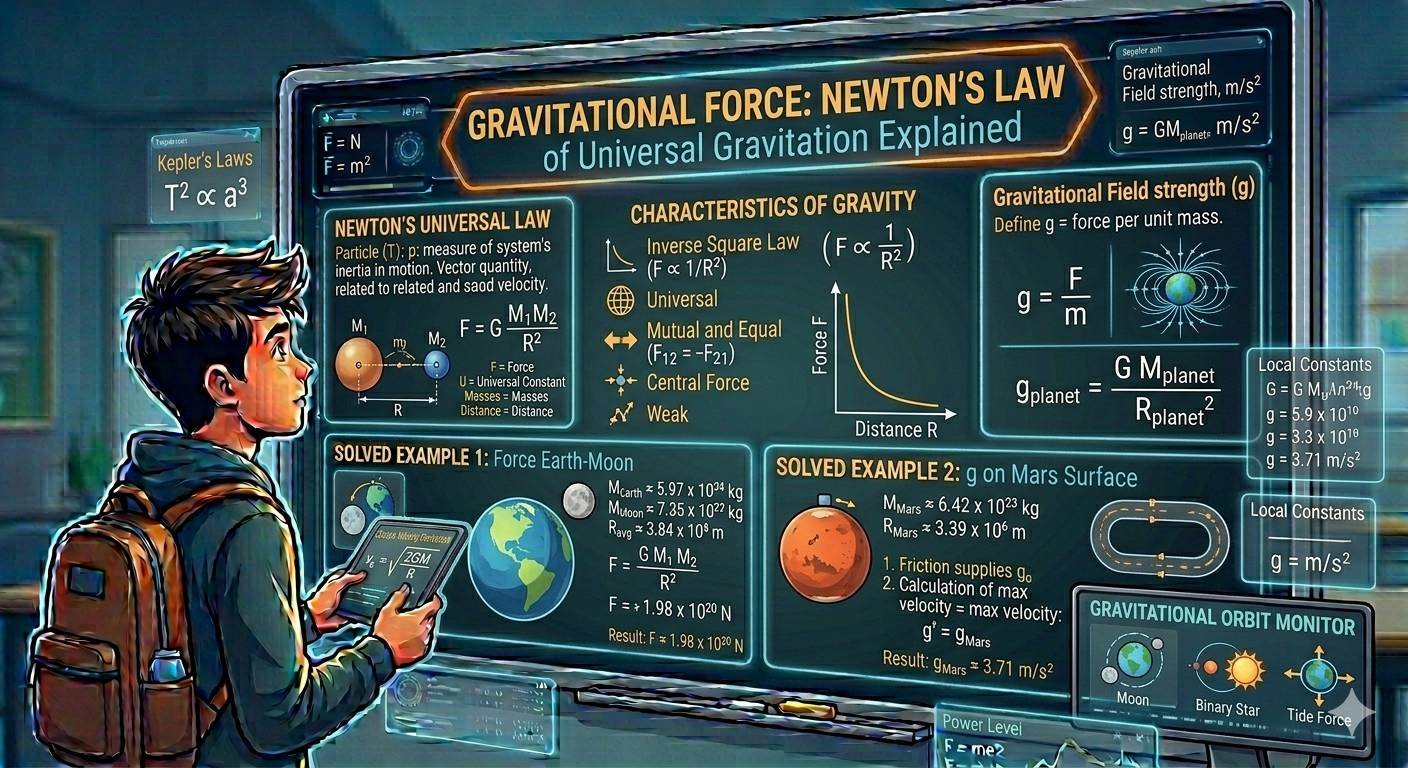
Newton’s law of universal gravitation states that every object in the universe attracts every other object with a force proportional to the product of their masses and inversely proportional to the square of the distance between them. This single law explains why apples fall, why the Moon orbits, and why galaxies hold together.
Gravity is the most familiar force in nature — and the most universally misunderstood. This guide covers the equation, the gravitational constant, the connection between g and G, and the myths about gravity in space.
Table of Contents
What Is Newton’s Law of Universal Gravitation?
Newton’s law says that any two objects with mass attract each other. The force is proportional to both masses and gets weaker with distance — specifically, it drops off as the square of the distance between them.
Isaac Newton reportedly began thinking about gravity after watching an apple fall (whether the “apple hit his head” version is myth or reality is debated). The insight was that the same force pulling the apple toward Earth also keeps the Moon in orbit. Gravity is not just an Earth-surface phenomenon — it is universal.
Newton published this law in Principia Mathematica (1687), alongside his three laws of motion. Together, they form the complete framework of classical mechanics.
The Gravitational Force Formula (F = Gm₁m₂/r²)
F = Gm₁m₂ / r²
- F = gravitational force between the two objects (in newtons)
- G = 6.674 × 10⁻¹¹ N·m²/kg² (universal gravitational constant)
- m₁, m₂ = masses of the two objects (in kg)
- r = distance between the centers of the two objects (in m)
This is an inverse-square law: double the distance and the force drops to one-quarter. Triple the distance and it drops to one-ninth.
The force is always attractive — gravity only pulls, never pushes. Both objects feel the same force (Newton’s Third Law — the Earth pulls you down with the same force you pull the Earth up). The reason you accelerate more than the Earth is that your mass is tiny compared to Earth’s (F = ma — same force, vastly different masses, vastly different accelerations).
What Is the Gravitational Constant (G)?
G is the universal gravitational constant: 6.674 × 10⁻¹¹ N·m²/kg².
It is an incredibly small number, which is why gravity between everyday objects is imperceptible. The gravitational pull between two 1 kg masses 1 meter apart is only 6.674 × 10⁻¹¹ N — far too small to feel or even measure without extremely sensitive equipment.
Henry Cavendish first measured G in 1798 using a torsion balance. He suspended a bar with two small lead balls from a thin wire, then brought two massive lead balls close to them. The gravitational attraction between the balls caused the wire to twist very slightly. By measuring the twist, Cavendish calculated G.
🌍 Real-World Connection: Cavendish’s experiment is often described as “weighing the Earth.” Once you know G and can measure the force of gravity (g), you can calculate Earth’s mass from g = GM/R². Cavendish’s result gave the first accurate estimate of Earth’s mass: about 6 × 10²⁴ kg.
The Connection Between g and G (Why g = 9.8 m/s²)
The familiar acceleration due to gravity, g = 9.8 m/s², is not a fundamental constant. It is a derived value that comes from Newton’s gravitation law.
The force on an object of mass m at Earth’s surface:
F = GMm/R²
But we also know from Newton’s Second Law: F = mg.
Setting these equal: mg = GMm/R² → g = GM/R²
Plugging in Earth’s values:
- M = 5.97 × 10²⁴ kg
- R = 6.37 × 10⁶ m
- G = 6.674 × 10⁻¹¹ N·m²/kg²
g = (6.674 × 10⁻¹¹)(5.97 × 10²⁴) / (6.37 × 10⁶)² = 3.986 × 10¹⁴ / 4.06 × 10¹³ = 9.8 m/s²
This derivation is deeply satisfying. The “9.8” that appears in every projectile motion and inclined plane problem is not a magic number — it is a direct consequence of how massive Earth is and how large its radius is.
Why Gravity Gets Weaker with Distance (Inverse-Square Law)
Gravitational force follows an inverse-square relationship with distance. As you move farther from a mass, the gravitational force decreases with the square of the distance.
At twice the distance: F drops to 1/4. At three times the distance: F drops to 1/9. At ten times the distance: F drops to 1/100.
But gravity never reaches zero. No matter how far away you are, some gravitational pull exists — it just becomes immeasurably small.
Why the inverse square? Imagine gravity spreading out uniformly in all directions from a mass, like light from a bulb. The “strength” of gravity at any distance is spread over the surface area of a sphere at that distance. Surface area of a sphere = 4πr². As r increases, the same total gravitational influence is spread over a larger area, diluting the force per unit area by 1/r².
Weight on Different Planets
Weight is the gravitational force on an object: W = mg. Since g depends on the planet’s mass and radius (g = GM/R²), your weight changes on every planet.
For a 70 kg person:
| Location | Surface Gravity (m/s²) | Weight (N) | Weight (kg equivalent) |
|---|---|---|---|
| Earth | 9.8 | 686 | 70 |
| Moon | 1.6 | 112 | 11.4 |
| Mars | 3.7 | 259 | 26.4 |
| Jupiter | 24.8 | 1736 | 177 |
| Sun (surface) | 274 | 19,180 | 1,957 |
On the Moon, you weigh about 1/6 of your Earth weight. On Jupiter, about 2.5 times. Your mass (70 kg) stays exactly the same everywhere — only the gravitational acceleration changes.
How Gravity Makes Orbits Possible
An orbit happens when an object moves sideways fast enough that its fall toward the planet curves along with the planet’s surface. The object is always falling — but it keeps missing the ground.
Gravity provides the centripetal force needed for circular orbit:
GMm/r² = mv²/r → v_orbital = √(GM/r)
For a satellite at 400 km above Earth (r = R + h = 6.77 × 10⁶ m):
v = √(3.986 × 10¹⁴ / 6.77 × 10⁶) = √(5.89 × 10⁷) = 7,670 m/s ≈ 27,600 km/h
That is about 17 times faster than a bullet. At this speed, the satellite circles Earth in about 90 minutes.
Escape velocity is the minimum speed needed to leave a planet’s gravitational pull entirely:
v_escape = √(2GM/R)
For Earth: v_escape = √(2 × 3.986 × 10¹⁴ / 6.37 × 10⁶) = 11,200 m/s ≈ 40,300 km/h.
The “No Gravity in Space” Myth — Debunked
📌 Common Misconception: “Astronauts float in space because there is no gravity.”
Completely wrong. The International Space Station orbits at about 400 km above Earth. At that altitude, gravity is about 89% of its surface value — the difference between 9.8 and 8.7 m/s² is small.
Astronauts float because they are in free fall. The ISS and everyone inside it are falling toward Earth — but moving sideways fast enough that they keep missing. Inside the falling station, everything falls together at the same rate, so nothing pushes against anything else. There is no floor pushing up on their feet (no normal force), so they feel weightless.
This is exactly what happens when an elevator cable snaps (briefly) or when you go over a hill fast — you feel momentarily weightless. It is not because gravity disappears. It is because you and your surroundings fall together.
📌 Common Misconception: “Heavier objects fall faster.”
Galileo disproved this in the 1600s. In a vacuum (no air resistance), a feather and a hammer fall at exactly the same rate. Apollo 15 astronaut David Scott demonstrated this on the Moon in 1971, dropping a hammer and a feather — they hit the lunar surface simultaneously.
Solved Problems on Gravitation
Problem 1: Force Between Earth and Moon
Earth mass: 5.97 × 10²⁴ kg. Moon mass: 7.35 × 10²² kg. Distance: 3.84 × 10⁸ m. Find the gravitational force.
F = GM₁M₂/r² = (6.674 × 10⁻¹¹)(5.97 × 10²⁴)(7.35 × 10²²) / (3.84 × 10⁸)²
F = (6.674 × 10⁻¹¹)(4.39 × 10⁴⁷) / (1.47 × 10¹⁷)
F = 2.93 × 10³⁷ / 1.47 × 10¹⁷ = 1.99 × 10²⁰ N
This enormous force keeps the Moon in its orbit around Earth.
Problem 2: Surface Gravity of Mars
Mars mass: 6.42 × 10²³ kg. Mars radius: 3.39 × 10⁶ m. Find surface gravity.
g_Mars = GM/R² = (6.674 × 10⁻¹¹)(6.42 × 10²³) / (3.39 × 10⁶)²
g_Mars = 4.28 × 10¹³ / 1.15 × 10¹³ = 3.72 m/s²
About 38% of Earth’s surface gravity. A 70 kg person would weigh 260 N on Mars (about 26.5 kg equivalent).
Problem 3: Orbital Velocity at 400 km
Find the orbital velocity for a satellite at 400 km above Earth.
r = 6.37 × 10⁶ + 4.0 × 10⁵ = 6.77 × 10⁶ m
v = √(GM/r) = √(3.986 × 10¹⁴ / 6.77 × 10⁶) = √(5.89 × 10⁷) = 7,670 m/s
The satellite must travel at about 7.7 km/s — roughly 27,600 km/h — to maintain a circular orbit at this altitude.
See the full topic map at the Classical Mechanics.
Frequently Asked Questions
What is Newton’s law of gravitation in simple words?
Every object with mass attracts every other object with mass. The force depends on both masses (bigger masses, stronger pull) and the distance between them (farther apart, weaker pull). This one law explains falling objects, orbiting planets, and the structure of the universe.
What is the formula for gravitational force?
F = Gm₁m₂/r², where G is the gravitational constant (6.674 × 10⁻¹¹ N·m²/kg²), m₁ and m₂ are the two masses, and r is the distance between their centers. The force is always attractive and follows the inverse-square law.
What is the value of gravitational constant G?
G = 6.674 × 10⁻¹¹ N·m²/kg². It was first measured by Henry Cavendish in 1798 using a torsion balance. G is universal — it has the same value everywhere in the universe. It is extremely small, which is why gravity between everyday objects is imperceptible.
Why do heavier objects not fall faster?
Because the gravitational force on a heavier object is greater, but so is its inertia (resistance to acceleration). Force = mg, and acceleration = F/m = mg/m = g. Mass cancels out. All objects accelerate at the same rate (g = 9.8 m/s²) regardless of mass. Galileo demonstrated this experimentally in the 1600s.
Is there gravity in space?
Yes. Gravity extends to infinity — it never disappears. At the altitude of the International Space Station (400 km), gravity is about 89% of its surface strength. Astronauts float not because gravity is absent, but because they and the station are in continuous free fall — falling around Earth together.
What is the difference between g and G?
G (capital) is the universal gravitational constant: 6.674 × 10⁻¹¹ N·m²/kg². It is the same everywhere. g (lowercase) is the acceleration due to gravity at a specific location: 9.8 m/s² on Earth’s surface, 1.6 m/s² on the Moon. They are related by g = GM/R² — g depends on the planet’s mass and radius.