
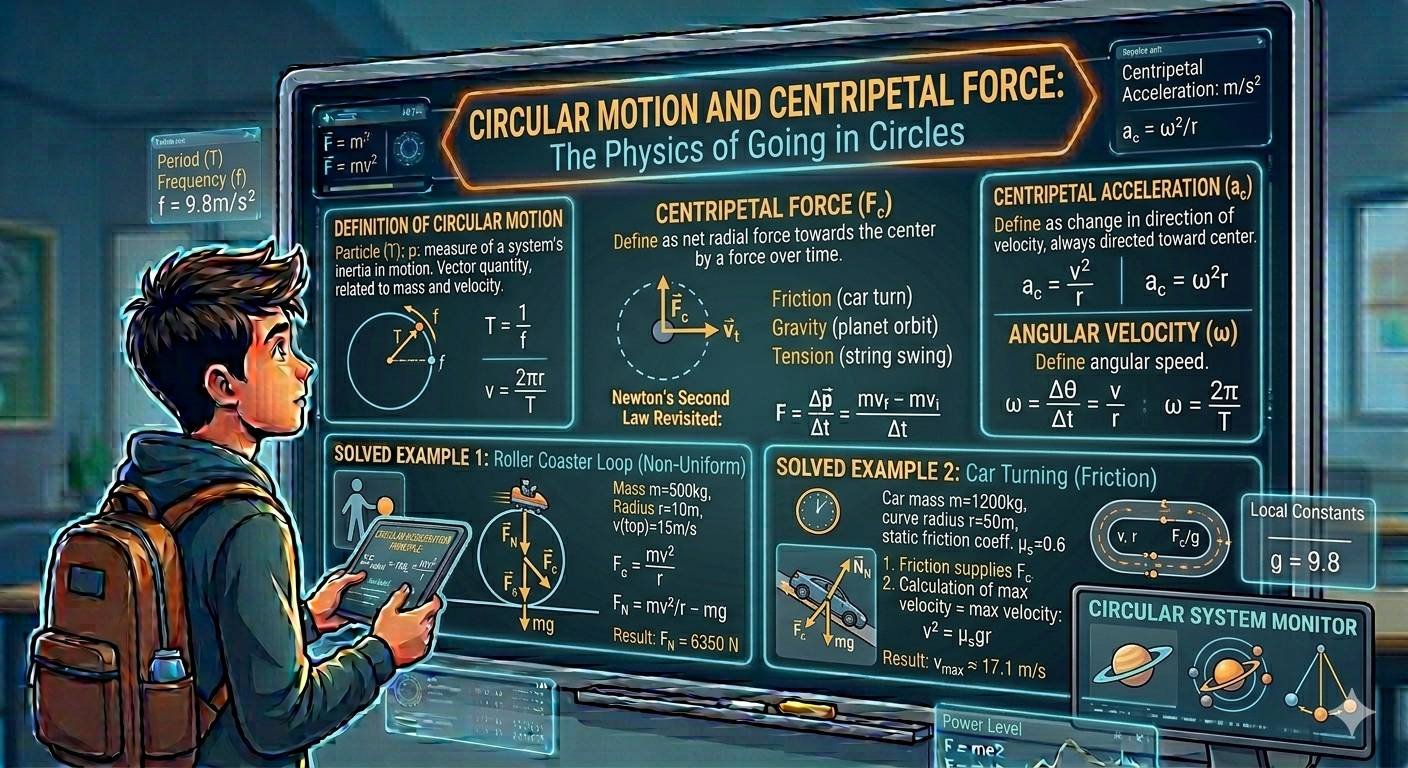
Centripetal force is the net force directed toward the center of a circular path that keeps an object moving in a circle. It is not a new type of force — it is a label for whatever force (gravity, friction, tension) happens to point inward.
Any object moving in a circle is accelerating, even if its speed never changes. That fact surprises most students, and it is the key to understanding everything about circular motion.
Table of Contents
What Is Circular Motion?
Circular motion is motion along a curved, circular path. When an object moves in a circle at constant speed, it is in uniform circular motion.
Even though the speed stays the same, the velocity is constantly changing. Why? Because velocity includes direction. An object moving north at 10 m/s, then east at 10 m/s, then south at 10 m/s has changed velocity three times — even though the speed was always 10 m/s.
Changing velocity means acceleration. And acceleration requires a force (Newton’s Second Law: F = ma). That force — always directed toward the center of the circle — is what we call centripetal force.
Centripetal Acceleration — Why Direction Change = Acceleration
Acceleration is any change in velocity — and velocity is speed with direction. So there are two ways to accelerate: change your speed, or change your direction.
In uniform circular motion, speed stays constant but direction changes continuously. The object is always “turning.” This turning requires an inward acceleration called centripetal acceleration.
a_c = v²/r = ω²r
- v = speed of the object
- r = radius of the circle
- ω = angular velocity (radians per second)
The acceleration always points toward the center of the circle. If it pointed in any other direction, the object would speed up, slow down, or spiral — not maintain a perfect circle.
Think of it this way: At every instant, the object wants to fly off in a straight line (Newton’s First Law — inertia). The centripetal acceleration constantly “pulls” it inward, bending the straight path into a curve. Without that inward pull, the object continues in a straight line — tangent to the circle.
Centripetal Force Formula (F = mv²/r)
Apply Newton’s Second Law to centripetal acceleration:
F_c = ma_c = mv²/r
- F_c = centripetal force (in newtons)
- m = mass of the object
- v = speed
- r = radius of the circle
This tells you how much inward force is needed to keep the object on its circular path. Faster speed or smaller radius demands more force.
What Provides the Centripetal Force? (It Depends on the Situation)
This is the crucial insight that most students miss. Centripetal force is not a new, separate force. It is the name for whatever real force points toward the center of the circle.
For a satellite orbiting Earth: Gravity provides the centripetal force. Gravity pulls the satellite inward toward Earth’s center.
For a car turning on a flat road: Friction between the tires and road provides the centripetal force, pointing toward the center of the turn.
For a ball on a string swung in a circle: Tension in the string provides the centripetal force.
For a roller coaster in a loop: At the top, gravity and normal force both point inward. At the bottom, normal force (up) minus gravity (down) provides the net inward force.
When solving problems, never write “centripetal force” as a separate force on a free body diagram. Instead, identify the real force(s) pointing toward the center and set their sum equal to mv²/r.
Centripetal vs Centrifugal Force — Which One Is Real?
Centripetal force is real. It is the net inward force (gravity, tension, friction) that keeps an object moving in a circle.
Centrifugal force is fictitious. It is an apparent outward force that appears only in a rotating (non-inertial) reference frame.
When a car turns right, you feel “pushed” to the left. But nothing pushes you outward. Your body wants to continue in a straight line (inertia). The car door pushes you inward (centripetal force). You feel “pushed out” because your reference frame (the car) is accelerating inward.
From outside the car (standing on the sidewalk), you would see the person’s body traveling straight while the car turns underneath them. There is no outward force — only the car turning into the person.
📌 Common Misconception: “Centrifugal force pushes you outward in a turning car.”
Nothing pushes you outward. Your body obeys Newton’s First Law — it wants to go straight. The car (via the door and seatbelt) pushes you inward. The “outward push” feeling is your inertia resisting the inward turn. In an inertial reference frame, centrifugal force does not exist.
In physics problems, always use centripetal force (inward) and Newton’s laws. Centrifugal force only appears in rotating reference frames and adds unnecessary complexity.
Circular Motion Examples in Everyday Life
Car on a curve. Friction between tires and road provides centripetal force. If the road is wet (lower friction), the car cannot turn as sharply — it skids outward in a straight line, not because of centrifugal force, but because friction is insufficient to curve the path.
Washing machine spin cycle. Clothes press against the drum wall. The drum wall pushes them inward (centripetal force). Water, not held by the fabric, exits through the drum holes — it does not get “flung outward” by a force; it simply continues in a straight line through the holes.
Earth orbiting the Sun. Gravity provides the centripetal force. The Sun’s gravitational pull bends Earth’s path into an (approximately) circular orbit.
Spinning bucket of water. Swing a bucket of water in a vertical circle. At the top, gravity pulls the water down and the bucket bottom pushes the water down — both toward the center. If the speed is high enough, the combined force exceeds what is needed for gravity alone, and the water stays in the bucket.
Circular Motion Problems — Solved Step by Step
Problem 1: Car on a Flat Curve
A 1000 kg car drives around a flat curve with radius 50 m at 20 m/s. What friction force is needed?
F_c = mv²/r = 1000 × 400/50 = 8000 N
This friction must be provided by the tires. If the maximum static friction is less than 8000 N, the car cannot make the turn and skids.
Check: On dry road (μ_s ≈ 0.7), max friction = 0.7 × 1000 × 9.8 = 6860 N. That is less than 8000 N — the car would skid at this speed. The driver needs to slow down or the curve needs banking.
Problem 2: Ball on a String
A 0.5 kg ball on a 1 m string moves in a horizontal circle with a period of 0.5 s. Find the tension.
First, find speed: v = 2πr/T = 2π(1)/0.5 = 12.6 m/s.
Tension provides centripetal force: T = mv²/r = 0.5 × (12.6)²/1 = 0.5 × 158.8 = 79.4 N.
That is substantial — about 8 kg equivalent of pull on the string.
Problem 3: Minimum Speed at Top of a Loop
A roller coaster car enters a vertical loop of radius 10 m. What minimum speed at the top keeps the car on the track?
At the top, both gravity and normal force point toward the center (downward). At the minimum speed, the normal force is zero — gravity alone provides all the centripetal force.
mg = mv²_min/r → v²_min = gr → v_min = √(9.8 × 10) = √98 = 9.9 m/s
Below this speed, the car loses contact with the track. In practice, coasters are designed to exceed this speed comfortably for safety.
Vertical Circular Motion (Loops and Swinging Buckets)
Vertical circular motion adds a complication: the weight vector changes its role at different positions.
At the bottom of the loop: The normal force pushes up (toward center), gravity pulls down (away from center). Net centripetal force = N − mg. So N = mg + mv²/r. You feel heavy — the normal force exceeds your weight.
At the top of the loop: The normal force pushes down (toward center), gravity pulls down (toward center). Net centripetal force = N + mg. So N = mv²/r − mg. You feel light. If speed is too low, N becomes zero and you fall.
The swinging bucket question: Why does water not fall out of a bucket swung in a vertical circle? At the top, the bucket needs centripetal acceleration v²/r directed downward. If v²/r > g, the bucket accelerates downward faster than free fall. The bucket “falls” faster than the water would on its own, so the bucket bottom presses against the water, keeping it in place.
Frequently Asked Questions
What is centripetal force in simple words?
Centripetal force is the inward force that keeps an object moving in a circle. It is not a new type of force — it is whatever real force (gravity, friction, tension) points toward the center of the circular path. Without it, the object would fly off in a straight line.
What is the formula for centripetal force?
F_c = mv²/r, where m is mass, v is speed, and r is the radius of the circle. This tells you how much inward force is needed. You can also write it as F_c = mω²r using angular velocity ω.
What is the difference between centripetal and centrifugal force?
Centripetal force is real — it is the net inward force (gravity, friction, tension) that keeps an object on a curved path. Centrifugal force is fictitious — it is an apparent outward force that seems to exist only when you are inside a rotating system. In physics problems, use centripetal force.
Is centrifugal force real?
No, not in an inertial (non-accelerating) reference frame. It is a fictitious or pseudo force that appears when you analyze motion from a rotating viewpoint. The “outward push” you feel in a turning car is actually your inertia (tendency to move straight) being redirected inward by the car. No real force pushes you outward.
What causes centripetal force?
Centripetal force is caused by real forces that happen to point toward the center of the circle. For orbiting objects, gravity is the cause. For cars on curves, friction is the cause. For objects on strings, tension is the cause. There is no single “centripetal force source” — it depends on the situation.
Why do you feel pushed outward in a turning car?
Your body wants to continue in a straight line (Newton’s First Law / inertia). When the car turns, the door or seatbelt pushes you inward toward the center of the turn. You perceive this as being “pushed outward,” but in reality, nothing pushes outward. The car is accelerating inward, and your body resists the change.