
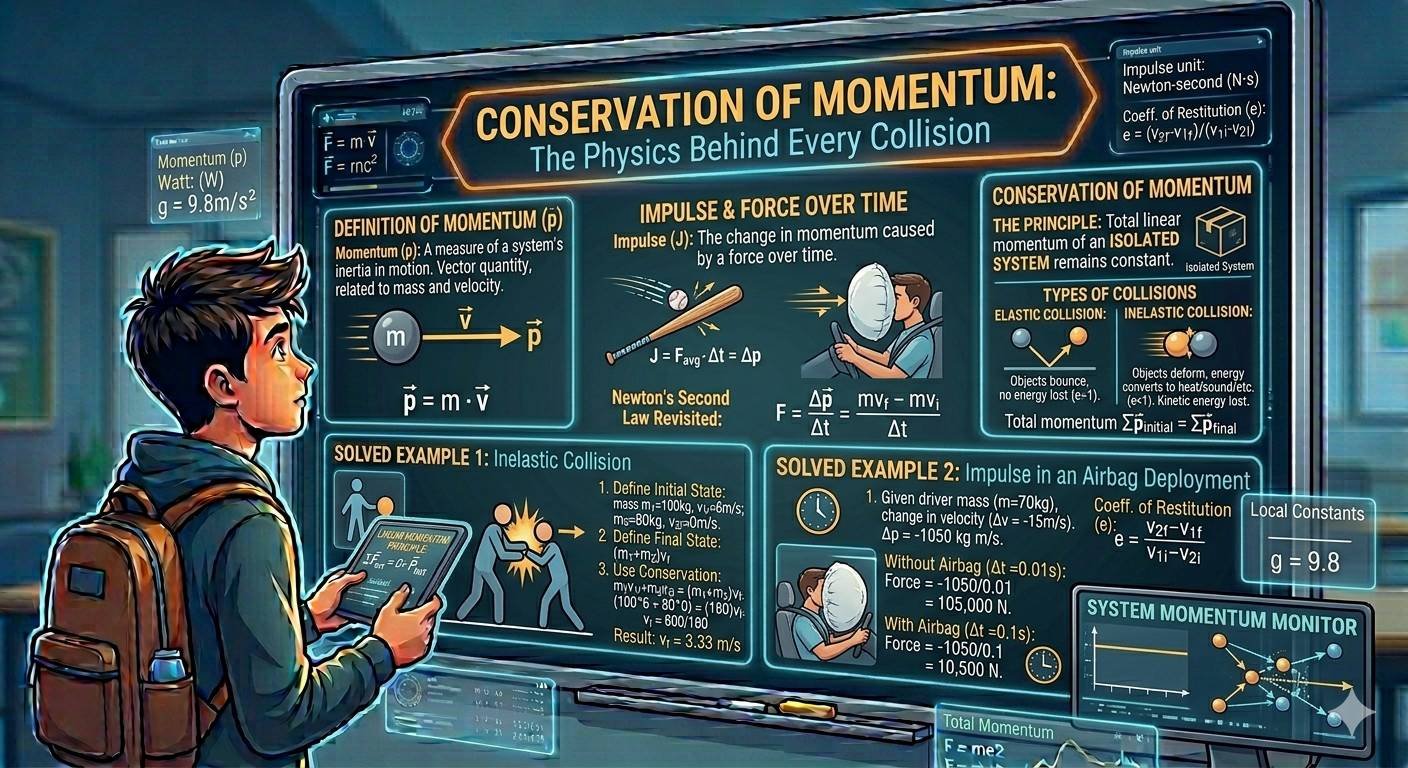
Conservation of momentum states that in an isolated system (no external forces), the total momentum before an event equals the total momentum after. This law governs every collision, every explosion, and every interaction between objects — from billiard balls to car crashes to rocket launches.
Momentum is the “quantity of motion” — it combines how much stuff is moving and how fast. Once you understand momentum, you understand why some crashes are survivable and others are not.
Table of Contents
What Is Momentum in Physics?
Momentum is mass in motion. Every moving object has momentum. The more massive it is and the faster it moves, the more momentum it carries.
A loaded freight train crawling at 5 km/h has enormous momentum because of its massive weight. A bullet has significant momentum despite being tiny because of its extreme speed. A parked car has zero momentum — no motion means no momentum.
Momentum is a vector quantity. It has both magnitude and direction. A ball moving east at 10 m/s and a ball moving west at 10 m/s have the same magnitude of momentum but opposite directions — they do not add up to the same thing.
The Momentum Formula (p = mv)
p = mv
- p = momentum (in kg·m/s)
- m = mass (in kg)
- v = velocity (in m/s, with direction)
A 5 kg bowling ball rolling at 8 m/s has momentum: p = 5 × 8 = 40 kg·m/s.
A 0.01 kg bullet at 400 m/s has momentum: p = 0.01 × 400 = 4 kg·m/s.
The bowling ball has 10 times the momentum of the bullet — even though the bullet is 50 times faster. Mass matters as much as speed.
Momentum is deeply connected to Newton’s Second Law. Newton originally wrote the second law not as F = ma, but as F = dp/dt — force equals the rate of change of momentum. When mass is constant, this simplifies to F = ma. But the momentum form is the more fundamental version.
What Is the Conservation of Momentum?
In an isolated system — one where no external forces act — the total momentum before any event equals the total momentum after.
m₁v₁ + m₂v₂ = m₁v₁’ + m₂v₂’
(Primed variables are the velocities after the event.)
This is not an approximation. It is exact. It holds for every collision, every explosion, and every interaction — as long as no external force interferes.
Where does conservation of momentum come from? It is a direct consequence of Newton’s Third Law. When two objects interact, object A exerts a force on B, and B exerts an equal and opposite force on A. These forces act for the same duration. Since impulse (force × time) equals change in momentum, A gains exactly as much momentum as B loses. The total is unchanged.
Mathematically: F_AB = −F_BA → F_AB Δt = −F_BA Δt → Δp_A = −Δp_B → total Δp = 0.
Impulse and the Impulse-Momentum Theorem
Impulse is the product of force and the time over which it acts.
J = FΔt = Δp
Impulse equals the change in momentum. A large force over a short time produces the same impulse (and the same momentum change) as a small force over a long time.
This has enormous practical implications. In a car crash, your momentum changes by a fixed amount (from mv to zero). The impulse is fixed. The only variable is how long the collision lasts.
Short collision time (hitting a wall) → large force → severe injuries. Long collision time (crumple zone, airbag, seatbelt) → small force → survivable injuries.
📌 Common Misconception: “Airbags cushion the impact.” More precisely, airbags increase the time over which your momentum changes. Since impulse (J = FΔt) is the same either way, a longer Δt means a smaller F. Less force on your body means fewer injuries.
Elastic vs Inelastic Collisions — What’s the Difference?
Elastic collision: Both momentum AND kinetic energy are conserved. The objects bounce off each other with no energy lost to deformation or heat. Billiard balls and atomic collisions come close to this ideal.
Inelastic collision: Momentum is conserved, but kinetic energy is NOT fully conserved. Some KE converts to heat, sound, and deformation. Most real-world collisions are inelastic.
Perfectly inelastic collision: The most extreme inelastic case — the objects stick together after impact. Maximum KE is lost. Car crashes where vehicles lock bumpers are approximately perfectly inelastic.
In every type of collision, momentum is conserved. The difference is whether kinetic energy is also conserved.
How to tell them apart: Calculate total KE before and after. If they are equal, it is elastic. If not, it is inelastic. If the objects stick together, it is perfectly inelastic.
Conservation of Momentum Examples in Real Life
Billiard balls. A cue ball strikes a stationary ball. The cue ball stops; the target ball moves off at the cue ball’s original speed. Momentum is transferred completely. This is nearly a perfectly elastic collision.
Newton’s cradle. Pull back one ball, release, and one ball swings out the other side. Why not two balls at half speed? Because both momentum AND energy must be conserved. The only solution that conserves both is one ball at the original speed.
Astronaut in space. An astronaut floating in space throws a wrench. The wrench gains momentum in one direction; the astronaut gains equal momentum in the opposite direction. Nobody pushed either of them externally — they just exchanged momentum between themselves.
Gun recoil. Before firing: total momentum = 0 (gun and bullet at rest). After firing: bullet goes forward, gun kicks backward. Total momentum is still zero. The backward momentum of the gun exactly equals the forward momentum of the bullet.
Why Car Crumple Zones Save Lives (Impulse Application)
Modern cars are engineered to crumple on impact. This is not a flaw — it is life-saving physics.
In a 60 km/h collision, a 70 kg occupant has momentum of about 70 × 16.7 = 1167 kg·m/s. That momentum must reach zero. The impulse is fixed at 1167 N·s.
Without crumple zone (rigid car): Collision lasts ~0.05 s. Average force = 1167/0.05 = 23,340 N — enough to be fatal.
With crumple zone: Collision lasts ~0.3 s. Average force = 1167/0.3 = 3,890 N — serious but potentially survivable.
The seatbelt and airbag extend the time even further for the occupant’s body. Together, crumple zone + seatbelt + airbag can increase collision time to ~0.5 s or more, reducing peak forces to levels the human body can withstand.
🌍 Real-World Connection: This is why old “solid steel” cars from the 1950s were actually more dangerous than modern cars that look like they fold up in a crash. The folding absorbs energy and extends collision time, protecting occupants.
Solved Momentum Problems (Step by Step)
Problem 1: Elastic Collision of Billiard Balls
Ball 1 (0.17 kg, moving at 5 m/s) hits stationary Ball 2 (0.17 kg). Elastic collision, head-on. Find velocities after.
For equal-mass elastic head-on collision, a remarkable simplification: the balls exchange velocities.
After collision: Ball 1 stops (v₁’ = 0), Ball 2 moves at 5 m/s (v₂’ = 5 m/s).
Verification — Momentum: 0.17 × 5 + 0 = 0 + 0.17 × 5 → 0.85 = 0.85 ✓ Verification — KE: ½(0.17)(25) + 0 = 0 + ½(0.17)(25) → 2.125 J = 2.125 J ✓
Problem 2: Perfectly Inelastic Collision (Car Crash)
A 1500 kg car at 20 m/s hits a stationary 1000 kg car. They lock together. Find the velocity after impact.
Conservation of momentum: m₁v₁ + m₂v₂ = (m₁ + m₂)v’ 1500(20) + 1000(0) = (1500 + 1000)v’ 30,000 = 2500v’ v’ = 12 m/s in the original direction.
KE before: ½(1500)(400) = 300,000 J. KE after: ½(2500)(144) = 180,000 J. KE lost: 120,000 J — 40% of the kinetic energy converted to heat, sound, and deformation.
Problem 3: Bullet Embedding in a Block
A 0.01 kg bullet at 400 m/s embeds in a 2 kg block on a frictionless surface. Find the block’s speed and the KE lost.
Conservation of momentum: 0.01(400) + 2(0) = (0.01 + 2)v’ 4 = 2.01v’ v’ = 1.99 m/s
KE before: ½(0.01)(160,000) = 800 J. KE after: ½(2.01)(3.96) = 3.98 J. KE lost: 796 J — over 99.5% of the kinetic energy is lost to heat and deformation. The bullet-block system barely moves despite the bullet’s high speed, because momentum (not energy) is what is conserved.
See the big picture at the Classical Mechanics.
Frequently Asked Questions
What is conservation of momentum in simple words?
When objects interact without outside interference, their total momentum stays the same. Whatever momentum one object gains, the other loses. Before and after a collision (or explosion, or any interaction), the total momentum is identical.
What is the formula for momentum?
Momentum equals mass times velocity: p = mv. The unit is kg·m/s. It is a vector — direction matters. A 2 kg ball moving at 3 m/s to the right has momentum of 6 kg·m/s to the right.
What is the difference between elastic and inelastic collision?
In an elastic collision, both momentum and kinetic energy are conserved — objects bounce with no energy lost. In an inelastic collision, momentum is conserved but some kinetic energy converts to heat, sound, or deformation. In a perfectly inelastic collision, objects stick together and the maximum possible KE is lost.
Is momentum conserved in all collisions?
Yes — momentum is conserved in every collision (elastic, inelastic, and perfectly inelastic), as long as no significant external forces act during the collision. Kinetic energy may or may not be conserved, but momentum always is.
What is impulse in physics?
Impulse is the product of force and the time for which it acts: J = FΔt. It equals the change in momentum: J = Δp. A large force over a short time produces the same impulse as a small force over a long time. This principle is the physics behind airbags and crumple zones.
How do airbags use conservation of momentum?
Airbags do not change the momentum change — that is fixed by the crash. They increase the time over which that change happens. Since impulse J = FΔt is constant, a longer time (Δt) means a smaller force (F) on the occupant. Less force means fewer injuries.