
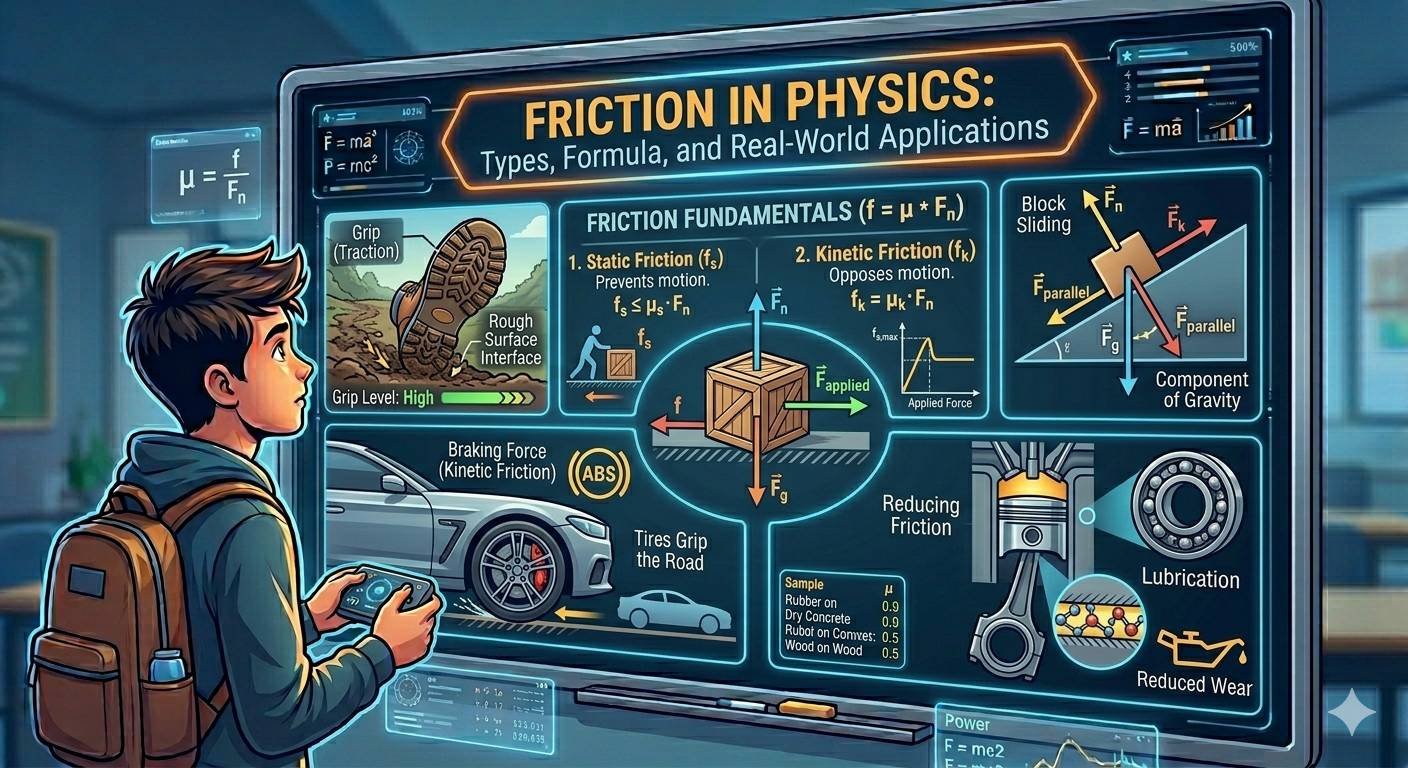
Friction is the force that resists the sliding, rolling, or flowing of one surface over another. It acts parallel to the contact surface and opposes relative motion between the two surfaces.
Without friction, you could not walk, hold a cup, write with a pen, or stop a car. Friction is not a flaw in the system — it is what makes most everyday activities possible.
Table of Contents
What Is Friction?
Friction is a contact force that arises whenever two surfaces interact. It opposes the relative motion (or attempted motion) between those surfaces.
At the microscopic level, friction comes from two sources. First, even smooth-looking surfaces have tiny bumps and ridges that interlock with each other. Second, molecules at the contact points form brief adhesive bonds. Both effects resist sliding.
The strength of friction depends on two things: how hard the surfaces are pressed together (the normal force) and the nature of the surfaces in contact (the coefficient of friction). It does not depend on the contact area — a surprising fact we will explain below.
Types of Friction (Static, Kinetic, Rolling, Fluid)
Static Friction keeps objects from starting to move. When you push a heavy box gently and it does not budge, static friction matches your push exactly. Push harder, and static friction increases to match — up to a maximum value. Exceed that maximum, and the box starts sliding.
Kinetic Friction acts on objects that are already sliding. Once the box is moving, kinetic friction takes over. It has a constant value that is always less than the maximum static friction.
Rolling Friction acts on wheels, balls, and cylinders rolling across a surface. It is much smaller than sliding friction, which is why wheels revolutionized transportation. A car tire on asphalt has a rolling friction coefficient around 0.01 — compared to about 0.7 for sliding rubber on asphalt.
Fluid Friction (Drag) acts on objects moving through liquids or gases. Air resistance on a falling skydiver and water resistance on a swimmer are both fluid friction. The force depends on speed, shape, and fluid density.
Static Friction vs Kinetic Friction — The Key Difference
This distinction is one of the most important in mechanics and one of the most commonly tested on exams.
Static friction is an inequality:
f_s ≤ μ_s · N
This means static friction adjusts to match the applied force — up to its maximum value of μ_s · N. If you push with 10 N and the box does not move, static friction is exactly 10 N. Push with 20 N, static friction is 20 N. Push with 40 N and the maximum is 39 N — the box starts to slide.
📌 Common Misconception: Students often write f_s = μ_s N as an equality. It is NOT an equality (except at the exact moment the object is about to slide). Static friction is whatever it needs to be to prevent motion, up to the maximum.
Kinetic friction is an equality:
f_k = μ_k · N
Once the object slides, kinetic friction is a fixed value. It does not change with speed (at least approximately, in the basic model).
A critical fact: μ_s > μ_k always. It takes more force to start something moving than to keep it moving. This is why pushing a heavy piece of furniture requires a big initial shove, and then it slides more easily.
Friction Force Formula (f = μN)
The general friction formula is:
f = μ · N
- f = friction force (in newtons)
- μ = coefficient of friction (dimensionless number, typically between 0 and 1)
- N = normal force (in newtons) — the force pressing the surfaces together
The normal force is NOT always equal to mg. On a flat surface, N = mg. On an inclined plane, N = mg cos θ. If someone pushes down on the object at an angle, N increases. If someone pulls up at an angle, N decreases. Always calculate N from a free body diagram before computing friction.
Coefficient of Friction Explained (With Values Table)
The coefficient of friction (μ) is a dimensionless number that captures how “grippy” a surface pair is. Higher μ means more friction.
| Surface Pair | μ_s (Static) | μ_k (Kinetic) |
|---|---|---|
| Rubber on dry concrete | 1.0 | 0.8 |
| Rubber on wet concrete | 0.7 | 0.5 |
| Wood on wood | 0.5 | 0.3 |
| Steel on steel | 0.6 | 0.4 |
| Ice on ice | 0.1 | 0.03 |
| Teflon on steel | 0.04 | 0.04 |
| Tire on dry road | 0.7 | 0.5 |
| Tire on wet road | 0.5 | 0.4 |
Notice that μ_s is always greater than μ_k for the same surface pair. Also notice the enormous range — rubber on concrete is 25 times grippier than ice on ice.
Why Is Static Friction Greater Than Kinetic Friction?
When two surfaces are stationary relative to each other, the microscopic bonds between them have time to form more completely. The tiny bumps settle into each other’s valleys. This creates stronger resistance.
Once sliding begins, the contact points are constantly breaking and reforming before they can fully bond. The surface bumps skip over each other instead of interlocking deeply. The result is less resistance — lower friction.
This is also why anti-lock braking systems (ABS) exist. When car wheels lock up during braking, the tires slide on the road (kinetic friction, μ ≈ 0.5 on wet roads). ABS prevents locking, keeping the tires rolling (static friction, μ ≈ 0.7 on wet roads). Static friction gives shorter stopping distances.
🌍 Real-World Connection: Before ABS was standard in cars, drivers were taught to pump their brakes to prevent wheel lockup. ABS does this automatically — it pulses the brakes up to 15 times per second to keep the tires at the edge of static friction, maximizing braking force.
Friction in Everyday Life — 10 Real Examples
- Walking — static friction between your shoe and the ground pushes you forward.
- Writing — friction between pen and paper transfers ink.
- Car brakes — brake pads press against rotors; friction converts kinetic energy to heat.
- Lighting a match — friction generates heat that ignites the match head.
- Rubbing hands for warmth — friction converts kinetic energy to thermal energy.
- Rock climbing shoes — high-μ rubber soles grip the rock surface.
- Conveyor belts — friction between belt and object carries items forward.
- Violin strings — the bow’s friction on the string creates vibration (sound).
- Chewing food — friction between teeth and food breaks it apart.
- Tying knots — friction between rope fibers prevents the knot from slipping.
When Friction Is Your Friend (And When It’s Not)
📌 Common Misconception: “Friction is always bad — it wastes energy.”
Wrong. Without friction, you could not walk, drive, grip anything, or stop moving. Friction is essential for almost every human activity. It is only “bad” when it causes unwanted wear or wastes energy (like in engine pistons or bicycle chains).
Friction helps: Walking, braking, gripping, climbing, writing, chewing, tying knots.
Friction hurts: Engine wear, joint friction in machines, drag on vehicles, heat generation in moving parts. Engineers use lubricants (oil, grease, Teflon coatings) to reduce friction where it is unwanted.
Why friction doesn’t depend on contact area: This surprises most students. A wide box and a narrow box of the same weight have the same friction on the same surface. Why? Because while the wide box has more contact area, the pressure (force per area) is lower. The narrow box has less area but higher pressure. The microscopic bonding effects scale with pressure × area = total force, which is the same for both. So friction depends on normal force, not area.
Friction Problems — Solved Step by Step
Problem 1: Starting and Keeping a Box Moving
A 10 kg box sits on a floor with μ_s = 0.5 and μ_k = 0.3. What force starts it? What force keeps it moving at constant speed?
To start: N = mg = 10 × 9.8 = 98 N. Maximum static friction: f_s = μ_s × N = 0.5 × 98 = 49 N. You need to push with more than 49 N to start it.
To keep moving at constant speed: Once sliding, kinetic friction takes over: f_k = μ_k × N = 0.3 × 98 = 29.4 N. Push with exactly 29.4 N for constant speed (net force = 0, using Newton’s Second Law, acceleration = 0).
Problem 2: Block on an Incline With Friction
A 5 kg box sits on a 30° incline with μ = 0.4. Does it slide? If so, find the acceleration.
Forces along the incline:
- Gravity component down slope: mg sin 30° = 5 × 9.8 × 0.5 = 24.5 N
- Normal force: N = mg cos 30° = 5 × 9.8 × 0.866 = 42.4 N
- Maximum static friction: f_s = 0.4 × 42.4 = 17.0 N
Since the gravity component (24.5 N) exceeds maximum static friction (17.0 N), the box does slide.
Acceleration: a = (mg sin θ − μ_k N) / m = (24.5 − 17.0) / 5 = 1.5 m/s² down the slope. (Using μ_k = μ here, as given.) More inclined plane problems are in our dedicated guide.
Problem 3: Stopping Distances — Wet vs. Dry
A 1000 kg car brakes from 20 m/s on dry road (μ = 0.7) vs. wet road (μ = 0.4). Compare stopping distances.
Dry road: Friction force: f = 0.7 × 1000 × 9.8 = 6860 N. Deceleration: a = 6860/1000 = 6.86 m/s². Stopping distance: d = v²/(2a) = 400/13.72 = 29.2 m.
Wet road: Friction force: f = 0.4 × 1000 × 9.8 = 3920 N. Deceleration: a = 3920/1000 = 3.92 m/s². Stopping distance: d = 400/7.84 = 51.0 m.
Wet roads increase stopping distance by 75%. This is why speed limits drop in rain. Use our Friction Calculator to test your own scenarios.
All friction concepts build on the foundation in our Classical Mechanics.
Frequently Asked Questions
What is friction in physics?
Friction is a contact force that resists the relative motion between two surfaces. It acts parallel to the contact surface. It arises from microscopic surface roughness and molecular adhesion between materials.
What are the 4 types of friction?
The four types are static friction (resists the start of motion), kinetic friction (acts during sliding), rolling friction (acts on rolling objects like wheels), and fluid friction or drag (acts on objects moving through liquids or gases).
What is the formula for friction force?
The friction force formula is f = μN, where μ is the coefficient of friction and N is the normal force. For static friction, it is an inequality: f_s ≤ μ_s N (it adjusts up to a maximum). For kinetic friction, it is an equality: f_k = μ_k N (constant once sliding).
What is coefficient of friction?
The coefficient of friction (μ) is a dimensionless number that represents how much friction a surface pair generates. Higher μ means more friction. Rubber on concrete has μ ≈ 0.8, while ice on ice has μ ≈ 0.03. It depends on both surfaces in contact.
Why is static friction greater than kinetic friction?
When surfaces are stationary, microscopic bonds between them have time to form fully and surface bumps interlock deeply. Once sliding begins, these bonds break and reform rapidly without fully developing, producing less resistance. This is why it takes more force to start an object moving than to keep it sliding.
Does friction depend on surface area?
No. Friction depends on the normal force and the coefficient of friction, not on the contact area. A wide box and a narrow box of the same weight on the same surface experience the same friction. The wider box has more area but lower pressure; the narrower box has less area but higher pressure. The effects cancel out.