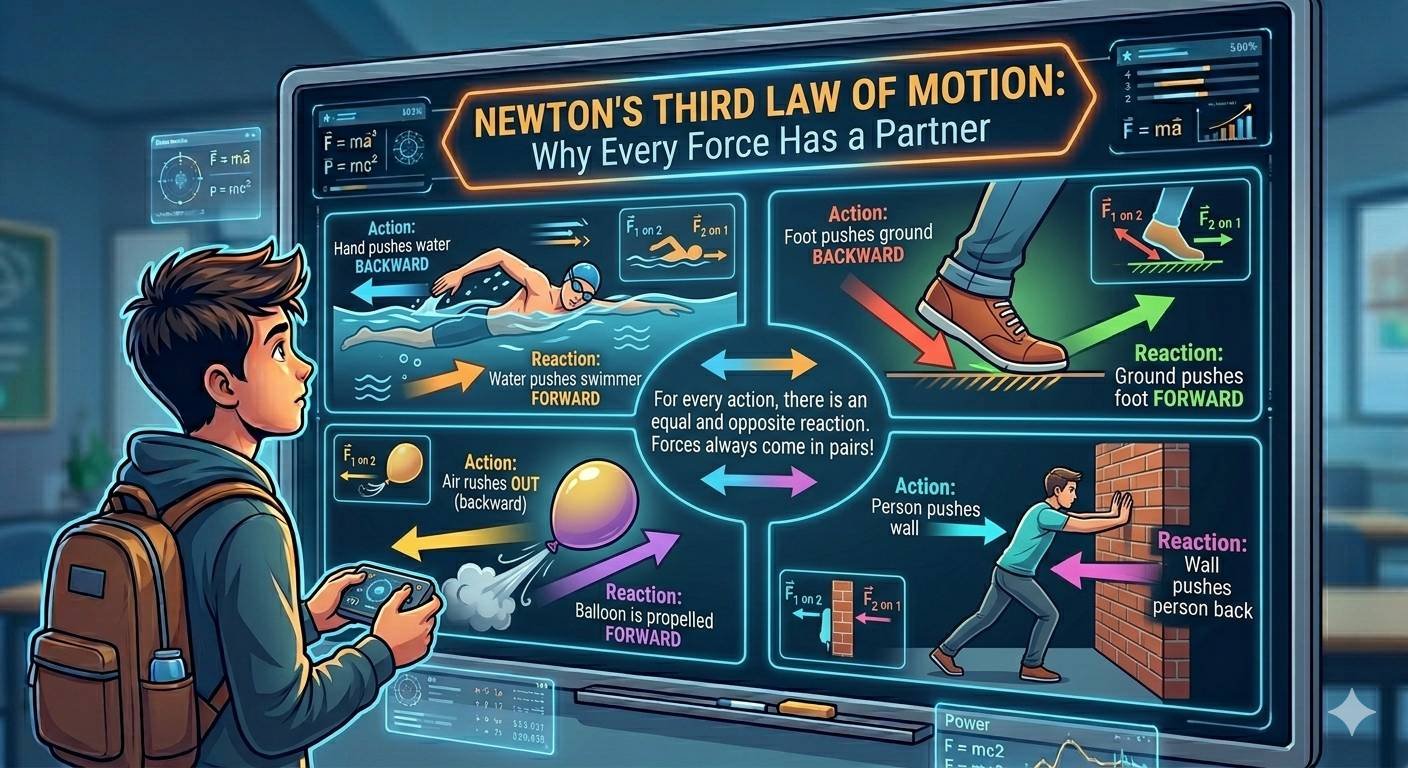
Newton’s third law states that for every action force, there is an equal and opposite reaction force. When you push a wall, the wall pushes you back with the exact same force. These forces always come in pairs, they always act on different objects, and they always appear simultaneously.
This law explains how rockets fly, how you walk, and how birds stay airborne. But it also creates one of the biggest misconceptions in all of physics — the belief that action and reaction “cancel out.” They do not, and understanding why is the key to mastering the Third Law.
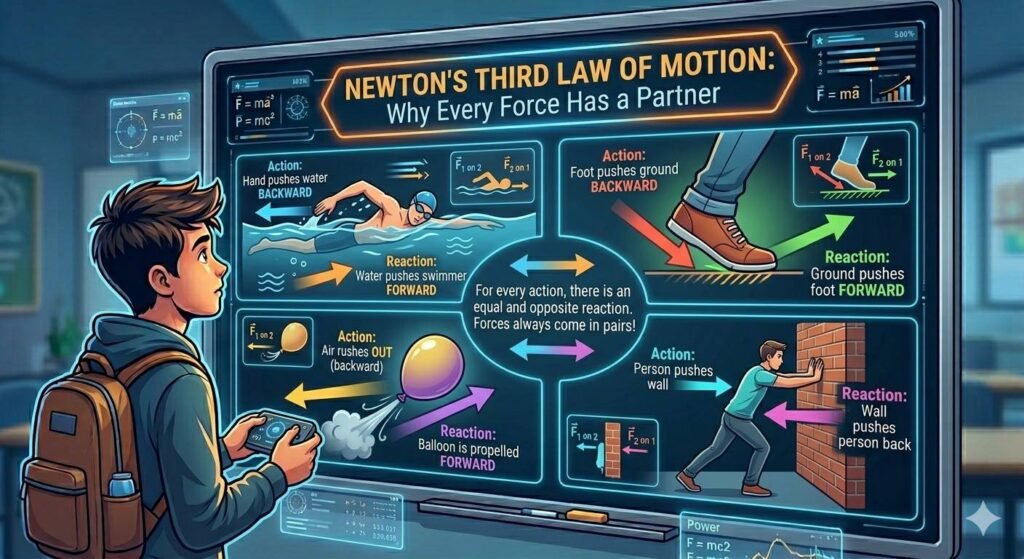
Table of Contents
What Is Newton’s Third Law of Motion?
Newton’s third law says: whenever object A exerts a force on object B, object B exerts a force of equal magnitude and opposite direction on object A. These two forces are called an action-reaction pair (or a Third-Law pair).
The forces are always equal in size, always opposite in direction, always the same type of force, and always act on different objects. That last point — different objects — is what makes the Third Law work without contradicting itself.
Isaac Newton included this law in Principia Mathematica (1687) alongside his first two laws. It completes the framework that makes all of classical mechanics internally consistent.
What Are Action-Reaction Pairs? (With Clear Examples)
Here are five Third-Law pairs you encounter every day.
Walking. Your foot pushes backward on the ground. The ground pushes your foot forward. That forward push from the ground is what propels you. Without it (on ice, for instance), your foot slides backward and you go nowhere. Friction between your shoe and the ground is the force that makes walking possible — and it is a Third-Law pair.
Swimming. Your hand pushes water backward. The water pushes your hand (and you) forward. Every stroke is a Third-Law pair in action.
Rocket propulsion. The rocket pushes exhaust gases downward at high speed. The exhaust gases push the rocket upward. This is how rockets work in the vacuum of space — they do not need air to “push against.” They push their own exhaust, and the exhaust pushes back.
Sitting in a chair. Your body pushes down on the chair (your weight). The chair pushes up on your body (the normal force). These are a Third-Law pair.
Earth and a falling apple. Earth’s gravity pulls the apple downward. The apple’s gravity pulls Earth upward. Yes, the apple pulls Earth — with the same force. Earth just does not noticeably accelerate because its mass is enormous (F = ma — same force, vastly more mass, negligibly tiny acceleration).
The Biggest Misconception: “Action and Reaction Cancel Out”
This is the #1 mistake students make with Newton’s Third Law, and it appears on exams at every level.
📌 Common Misconception: “If action and reaction are equal and opposite, they cancel out and nothing should ever move.”
Wrong. They do NOT cancel because they act on different objects. Forces only cancel when they act on the same object.
Consider you pushing a box across the floor. You push the box with 50 N to the right. The box pushes you back with 50 N to the left. These are the Third-Law pair.
Do they cancel? No — because one force acts on the box and the other acts on you. To determine whether the box accelerates, you only look at forces on the box. The box feels your 50 N push forward and friction’s resistance backward. If your push exceeds friction, the box accelerates. The force the box exerts on you is irrelevant to the box’s motion — it acts on a different object (you).
Forces cancel only when they are on the same object. Gravity pulling a book down and the normal force pushing it up are on the same object (the book), so they can cancel (and do, in equilibrium). But those are NOT a Third-Law pair — they are different types of forces (gravity vs. normal) and both act on the same object.
Newton’s Third Law vs Balanced Forces — The Critical Difference
This distinction is essential and is tested constantly.
Third-Law pairs:
- Equal magnitude, opposite direction
- Same type of force
- Act on DIFFERENT objects
- Always exist (every force has a partner)
Balanced forces:
- Equal magnitude, opposite direction
- Can be different types of force
- Act on the SAME object
- Only exist when the object is in equilibrium (a = 0)
The book-on-table test: A book sits on a table. Identify the forces.
The book has two forces on it: gravity (mg, downward) and normal force from the table (N, upward). These are balanced forces on the same object. They result in zero net force, so the book stays at rest (Newton’s First Law).
Now identify the actual Third-Law pairs:
- Pair 1: Earth pulls book down (gravity). Book pulls Earth up (gravity). Same type of force, different objects.
- Pair 2: Book pushes table down (contact force). Table pushes book up (normal force). Same type of force, different objects.
Notice: gravity on the book and the normal force on the book are NOT a Third-Law pair. They are different types of forces acting on the same object. This is the subtlety most students miss.
Newton’s Third Law Examples in Daily Life
A gun’s recoil. When a gun fires, it pushes the bullet forward. The bullet pushes the gun backward. The forces are equal. The bullet accelerates much more because it has much less mass (a = F/m).
Jumping. Your legs push downward on the ground. The ground pushes upward on you. That upward push lifts you off the ground. You cannot jump without a surface to push against.
A book pushed against a wall. You push the book into the wall with 20 N. The wall pushes back on the book with 20 N. Net force on the book (horizontally) is zero — it does not accelerate through the wall.
Bird flight. A bird’s wing pushes air downward. The air pushes the wing upward (lift). A bird’s wing also pushes air backward during a downstroke. The air pushes the bird forward (thrust). Every wing beat is a Third-Law pair.
📌 Common Misconception: “The action force happens first, and the reaction follows.”
Wrong. Both forces appear at exactly the same instant and disappear at the same instant. There is no time delay. Calling one “action” and the other “reaction” is just a naming convention — either force could be labeled either way.
How Rockets Work (Newton’s Third Law in Action)
Rockets are the most dramatic example of the Third Law. A rocket engine burns fuel and expels hot gases at tremendous speed out the back. The rocket pushes the exhaust backward; the exhaust pushes the rocket forward.
No air is needed. No ground is needed. The rocket and its exhaust are the two objects in the Third-Law pair. This is why rockets work perfectly in the vacuum of space.
The force on the rocket depends on how much exhaust mass is expelled per second and how fast it is expelled. This connects to conservation of momentum: the backward momentum of the exhaust exactly equals the forward momentum gained by the rocket.
🌍 Real-World Connection: Every spacecraft from the Apollo Moon missions to SpaceX Falcon 9 operates on Newton’s Third Law. Jet engines work the same way — they push air backward and the air pushes the plane forward. Even a squid propels itself by shooting water backward.
Identifying Third-Law Pairs (Step-by-Step Method)
Use this four-point test to verify whether two forces form a Third-Law pair:
- Equal magnitude? The forces must be the same size.
- Opposite direction? They must point in opposite directions.
- Same type of force? If one is gravitational, the other must be gravitational. If one is a normal (contact) force, the other must be a normal force.
- Different objects? They must act on two different objects.
If all four are true, you have a Third-Law pair. If any one fails, you do not.
Apply this test whenever you are unsure. Drawing a free body diagram for each object separately makes the pairs much easier to spot.
Newton’s Third Law Problems (Solved)
Problem 1: Person Standing on a Scale
A 60 kg person stands on a bathroom scale on the floor. Identify all Third-Law pairs.
Solution: The forces present:
- Person’s weight: Earth pulls person down (gravity).
- Person pushes scale down (contact force).
- Scale pushes person up (normal force).
- Scale pushes floor down (contact force).
- Floor pushes scale up (normal force).
- Person pulls Earth up (gravity).
Third-Law pairs:
- Pair 1: Earth pulls person down ↔ Person pulls Earth up. (Gravitational, equal and opposite, different objects.)
- Pair 2: Person pushes scale down ↔ Scale pushes person up. (Contact/normal, equal and opposite, different objects.)
- Pair 3: Scale pushes floor down ↔ Floor pushes scale up. (Contact/normal, equal and opposite, different objects.)
Problem 2: The Horse-and-Cart Paradox
A horse pulls a cart. The cart pulls the horse backward with the same force (Third Law). If the forces are equal and opposite, how does the system move?
Solution: The Third-Law pair (horse pulls cart forward, cart pulls horse backward) acts on different objects. To determine whether the cart accelerates, look only at forces on the cart: the horse’s pull forward and friction/drag backward. If the horse’s pull exceeds friction, the cart accelerates forward.
To determine whether the horse accelerates, look only at forces on the horse: the ground pushes the horse forward (the horse’s hooves push backward on the ground — Third Law), and the cart pulls the horse backward. If the ground’s forward push exceeds the cart’s backward pull, the horse accelerates forward.
The system moves because the horse generates a forward force from the ground that is larger than the cart’s resistance. The Third-Law pair between horse and cart does not cancel because the forces are on different objects.
How the Three Laws of Motion Work Together
The three laws form a unified system.
The First Law says: without net force, motion does not change. The Second Law (F = ma) says: with net force, here is exactly how motion changes. The Third Law says: forces always come in pairs on different objects, which is how you identify every force that appears on a free body diagram.
In practice, the Third Law is your force-finding tool. Use it to identify every force acting on your chosen object. Then use the Second Law to calculate the resulting acceleration. The First Law is the special case where all forces balance and acceleration is zero.
All three connect back to the broader framework in our Classical Mechanics.
Frequently Asked Questions
What is Newton’s third law of motion in simple terms?
Every force has a partner. When you push something, it pushes you back just as hard. These paired forces are always equal in size, opposite in direction, and act on two different objects. No force in the universe exists alone.
What is an example of action and reaction?
When you walk, your foot pushes backward on the ground (action) and the ground pushes your foot forward (reaction). This forward push is what moves you. The forces are equal in size, opposite in direction, and act on different objects (your foot and the ground).
Do action and reaction forces cancel each other out?
No. They act on different objects, so they cannot cancel. Forces only cancel when they act on the same object. The force of your foot on the ground and the ground’s force on your foot are on different objects, so each object responds independently.
Why don’t action and reaction cancel?
Because cancellation requires forces to act on the same object. Action-reaction pairs always act on two different objects. To analyze an object’s motion, you consider only the forces on that one object. The reaction force on the other object is irrelevant to the first object’s acceleration.
How does Newton’s third law apply to rockets?
A rocket pushes exhaust gas backward at high speed. The exhaust pushes the rocket forward with an equal force. The rocket and exhaust are the two objects in the Third-Law pair. No air or ground is needed — which is why rockets work in the vacuum of space.
What is the difference between Newton’s third law and balanced forces?
Third-Law pairs act on two different objects, are always the same type of force, and always exist. Balanced forces act on the same object, can be different types of force (like gravity and normal force), and only occur when the object is in equilibrium. The gravity on a book and the table’s normal force are balanced forces, not a Third-Law pair.