
Newton’s second law states that the net force acting on an object equals its mass times its acceleration. In equation form: F = ma. This single equation is the mathematical engine of all classical mechanics — it lets you predict exactly how any object will move when forces act on it.
If the first law tells you that forces change motion, the second law tells you how much and in what direction. Every engineering calculation involving motion, every physics exam problem, and every rocket trajectory starts with F = ma.
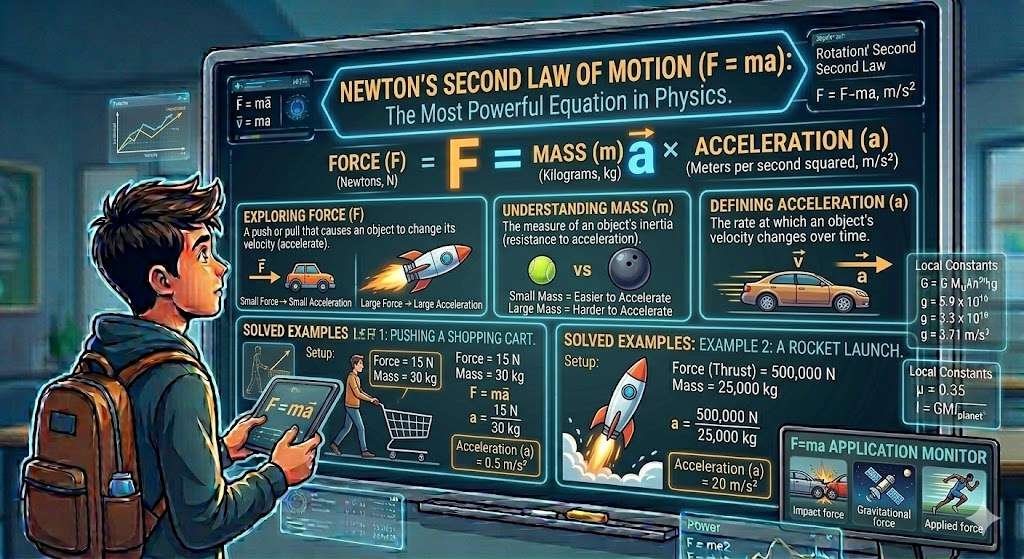
What Is Newton’s Second Law of Motion?
Newton’s second law says that when a net force acts on an object, the object accelerates in the direction of that force. The acceleration is directly proportional to the force and inversely proportional to the mass.
Push harder, and the object accelerates more. Make the object heavier, and the same push produces less acceleration. This relationship is complete, precise, and universal for everyday objects.
Isaac Newton published this law in his Principia Mathematica (1687). It connects force, mass, and acceleration in a way that lets you calculate any one of the three if you know the other two.
Understanding F = ma — What Each Variable Means
F = ma looks simple, but each variable carries important meaning.
F (Net Force): This is not just any force — it is the total of all forces acting on the object, combined as vectors. If three forces pull in different directions, you must add them (accounting for direction) to get the net force. Only the net force determines acceleration.
Think of a tug-of-war. If one team pulls with 500 N to the left and the other pulls with 450 N to the right, the net force is 50 N to the left. That net force — not either individual pull — determines the motion.
m (Mass): The amount of matter in the object, measured in kilograms. Mass is a measure of inertia — how much the object resists acceleration. Mass does not change with location. You have the same mass on Earth, the Moon, or floating in space.
a (Acceleration): The rate at which velocity changes, measured in m/s². Acceleration has both magnitude and direction. An object can accelerate by speeding up, slowing down, or changing direction.
Newton’s Second Law Formula and Units
The standard form is:
F_net = ma
The unit of force is the newton (N), defined as:
1 N = 1 kg × 1 m/s² = 1 kg·m/s²
One newton is roughly the weight of a small apple. In fact, the story goes that Newton (the person) was inspired by watching an apple fall — and the unit named after him (the newton) equals about one apple’s weight. A neat coincidence.
You can rearrange the equation three ways:
- F = ma (find force)
- a = F/m (find acceleration)
- m = F/a (find mass)
The equation is a vector equation. This means F and a point in the same direction. If the net force points east, the acceleration points east. If the net force points down a ramp, the acceleration points down the ramp.
The Difference Between Mass and Weight
This is one of the most important distinctions in physics, and one of the most commonly confused.
Mass is the amount of matter in an object. It is measured in kilograms. It does not change with location. A 70 kg person is 70 kg on Earth, on the Moon, and in deep space.
Weight is the gravitational force acting on an object. It is measured in newtons. It changes depending on the local gravitational acceleration.
W = mg
On Earth, g = 9.8 m/s², so a 70 kg person weighs 70 × 9.8 = 686 N. On the Moon (g ≈ 1.6 m/s²), the same person weighs only 112 N — about one-sixth of their Earth weight. Their mass is unchanged.
📌 Common Misconception: “I weigh 70 kg.”
Technically, 70 kg is your mass, not your weight. Your weight is approximately 686 N on Earth. In everyday language, people use “weight” to mean mass, but in physics, the distinction matters enormously — especially in F = ma problems.
When you stand on a bathroom scale, the scale measures the normal force, which equals your weight when you are stationary. In an accelerating elevator, the scale reading changes — which brings us to one of the best F = ma problems.
Newton’s Second Law Examples (Solved Step-by-Step)
Problem 1 (Basic): Pushing a Box
A net force of 15 N acts on a 5 kg box. What is the acceleration?
Solution:
- F_net = 15 N, m = 5 kg
- a = F/m = 15/5 = 3 m/s²
The box accelerates at 3 meters per second per second in the direction of the net force.
Problem 2 (Intermediate): Elevator Scale Reading
A 70 kg person stands on a scale inside an elevator that accelerates upward at 2 m/s². What does the scale read?
Solution: Draw a free body diagram. Two forces act on the person: weight (mg = 70 × 9.8 = 686 N, downward) and normal force from the scale (N, upward).
Apply F = ma in the vertical direction (up = positive):
- N − mg = ma
- N − 686 = 70 × 2
- N = 686 + 140 = 826 N
The scale reads 826 N — about 84 kg equivalent. The person “feels heavier” because the elevator accelerates upward. This is why your stomach drops when an elevator starts descending (N < mg, so you feel lighter).
Problem 3 (Advanced): Car on an Incline With Friction
A 1000 kg car is on a 30° incline. The coefficient of kinetic friction is μ_k = 0.3. Find the acceleration down the slope.
Solution: The forces parallel to the incline:
- Component of gravity down the slope: mg sin 30° = 1000 × 9.8 × 0.5 = 4900 N
- Normal force: N = mg cos 30° = 1000 × 9.8 × 0.866 = 8487 N
- Friction force up the slope: f_k = μ_k × N = 0.3 × 8487 = 2546 N
Net force down the slope: 4900 − 2546 = 2354 N
Acceleration: a = F_net / m = 2354 / 1000 = 2.35 m/s² down the slope.
For more on how to handle inclines, see our Inclined Plane Problems guide. For friction details, visit the Friction article.
How to Apply F = ma to Any Problem (Method)
This step-by-step method works for every force-and-acceleration problem.
Step 1: Draw a free body diagram. Isolate the object. Draw every force acting on it as an arrow. Include weight, normal force, friction, tension, and any applied force. Our Free Body Diagram guide teaches this skill in full.
Step 2: Choose coordinate axes. Pick x and y directions. For flat surfaces, horizontal and vertical work well. For ramps, tilt your axes to align with the slope.
Step 3: Break forces into components. Any force that does not align with an axis gets split into x and y components using sine and cosine.
Step 4: Write F = ma for each axis. ΣF_x = ma_x and ΣF_y = ma_y. Plug in all components.
Step 5: Solve. Often one axis gives you the normal force (useful for friction calculations), and the other axis gives you the acceleration.
Use the F = ma Calculator to check your work.
Newton’s Second Law as a Vector Equation
F = ma is actually a vector equation. Both force and acceleration have direction — they are not just numbers.
In two dimensions, the equation splits into components:
- F_x = ma_x (horizontal)
- F_y = ma_y (vertical)
This is essential for problems involving forces at angles. A rope pulling a sled at 30° above horizontal has both a horizontal component (which accelerates the sled forward) and a vertical component (which partially lifts the sled, reducing the normal force and therefore reducing friction).
Breaking forces into components is the single most important algebraic skill in mechanics. Every problem with angled forces requires it.
The Deeper Form: F = dp/dt (Force as Rate of Change of Momentum)
Newton did not originally write F = ma. He wrote something more general:
F = dp/dt
This means force equals the rate of change of momentum, where momentum p = mv. When mass is constant (most everyday situations), dp/dt simplifies to m(dv/dt) = ma. So F = ma is a special case of the deeper law.
Why does the deeper form matter? Because some systems have changing mass. A rocket burns fuel and gets lighter as it flies. A conveyor belt gains mass as objects are dropped onto it. For these systems, F = ma does not work — you need F = dp/dt.
This connection between force and momentum also leads to the impulse-momentum theorem (J = FΔt = Δp), which is the physics behind airbags, crumple zones, and every collision analysis.
🌍 Real-World Connection: SpaceX rockets lose thousands of kilograms of fuel per second during launch. Engineers cannot use F = ma directly — they use the momentum form to account for the continually decreasing mass. The thrust equation for rockets is derived entirely from F = dp/dt.
Common Mistakes Students Make with F = ma
📌 Mistake 1: Using a single force instead of net force.
If you push a box with 50 N but friction pushes back with 20 N, the net force is 30 N — not 50 N. Always add up ALL forces before dividing by mass. This is why free body diagrams are non-negotiable.
📌 Mistake 2: Confusing mass and weight.
Mass (kg) goes into F = ma. Weight (N) is a force (mg). If a problem says “a 10 kg block,” its weight is 98 N. If a problem says “a 50 N force of gravity,” the mass is about 5.1 kg. Read carefully.
Mistake 3: Forgetting to decompose forces. When a force acts at an angle, you cannot just plug the full force into F = ma. You must break it into components along your chosen axes. The horizontal component accelerates the object horizontally; the vertical component affects the normal force.
These three mistakes account for the vast majority of errors on physics exams. Fix them, and your problem-solving accuracy jumps immediately.
Frequently Asked Questions
What is Newton’s second law in simple words?
The harder you push something, the faster it speeds up. The heavier it is, the slower it speeds up for the same push. Newton’s second law (F = ma) makes this relationship precise and mathematical.
What is the formula for Newton’s second law?
F_net = ma, where F_net is the net (total) force in newtons, m is the mass in kilograms, and a is the acceleration in meters per second squared. You can rearrange it to find any of the three variables.
What is the unit of force in Newton’s second law?
The unit of force is the newton (N). One newton equals one kilogram times one meter per second squared (1 N = 1 kg·m/s²). It is named after Isaac Newton and is roughly equal to the weight of a small apple.
What is the difference between mass and weight?
Mass is the amount of matter in an object (in kg) and does not change with location. Weight is the gravitational force on that mass (in N) and equals mg. A 10 kg object weighs 98 N on Earth but only about 16 N on the Moon. Mass stays 10 kg in both places.
How do you solve Newton’s second law problems?
Draw a free body diagram, choose coordinate axes, break all forces into components, write ΣF = ma for each axis, and solve. The key is using net force (the sum of ALL forces), not just one force. Check units and direction of your answer.
Why is F = ma the most important equation in physics?
Because it connects the cause of motion (force) to the result (acceleration) through a measurable property (mass). Nearly every physics problem in mechanics, engineering, biomechanics, and aerospace comes down to applying F = ma in some form. It is the equation that turns physics from description into prediction.
Everything in this article connects back to the Classical Mechanics pillar page, which maps how all these concepts fit together.