
Newton’s first law states that an object stays at rest or keeps moving at constant speed in a straight line unless a net external force acts on it. This means motion does not need a cause — stopping does.
This concept is called inertia, and it completely overturns the way most people intuitively think about how things move. Before Newton, almost everyone believed (as Aristotle taught) that objects naturally slow down and stop. Newton proved the opposite: objects naturally keep doing whatever they are already doing.
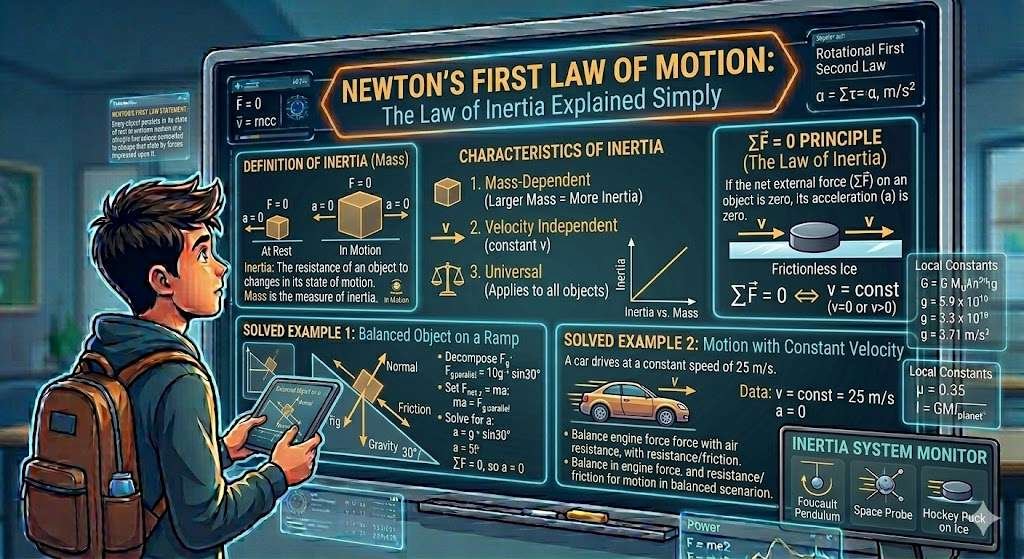
Table of Contents
What Is Newton’s First Law of Motion?
Newton’s first law says that if the net force on an object is zero, its velocity does not change. An object at rest stays at rest. An object moving at 10 m/s in a straight line keeps moving at 10 m/s in a straight line — forever — unless something pushes or pulls on it.
In mathematical shorthand: ΣF = 0 → a = 0.
When the total of all forces adds up to zero, acceleration is zero. Zero acceleration means zero change in velocity. The object either stays still or cruises at the same speed and direction indefinitely.
Isaac Newton published this law in his Principia Mathematica in 1687, building directly on the groundwork laid by Galileo Galilei decades earlier.
What Is Inertia? (Why Objects Resist Change)
Inertia is the tendency of an object to resist any change in its state of motion. Think of it as stubbornness — the more mass an object has, the more it resists being pushed around.
A bowling ball is hard to get moving and hard to stop. A tennis ball is easy. The bowling ball has more inertia because it has more mass. Mass is the direct measure of inertia.
You feel inertia every time a bus brakes suddenly. Your body was moving forward with the bus. When the bus stops, your body wants to keep moving forward (inertia), so you lurch ahead. The bus stopped — you did not — because no force acted on your upper body to slow it down.
🌍 Real-World Connection: Seatbelts exist entirely because of inertia. In a crash, the car stops suddenly. Your body, obeying the First Law, wants to keep moving at the car’s original speed. Without a seatbelt, you continue forward into the dashboard or windshield. The seatbelt applies the external force needed to decelerate your body along with the car.
Newton’s First Law Examples in Everyday Life
The First Law is happening everywhere, all the time. Here are examples you experience regularly.
Passengers in a braking car. When a car stops suddenly, passengers pitch forward. Their bodies were moving at the car’s speed. The car stopped (brakes applied force to the car), but no force stopped the passengers — so they keep moving forward until the seatbelt intervenes.
A tablecloth trick. Yank a tablecloth from under dishes quickly enough, and the dishes stay put. The dishes have inertia — they resist the brief horizontal tug. The friction between cloth and dishes acts for too short a time to overcome their inertia.
A hockey puck on ice. Slide a puck on smooth ice and it travels an enormous distance before stopping. Ice provides very little friction (very little external force), so the puck’s inertia keeps it gliding. On a perfectly frictionless surface, it would slide forever.
A satellite in orbit. Once a satellite reaches its orbital speed, no engine is needed to keep it moving. There is essentially no air resistance in space, so no external force slows it down. It continues at the same speed indefinitely — pure First Law in action.
🧪 Try This at Home: Place a coin on top of a small piece of cardboard balanced on the rim of a glass. Flick the cardboard sideways. The card flies out, but the coin drops straight into the glass. The coin’s inertia kept it in place while the card was knocked away. This is Newton’s First Law you can see in your kitchen.
The Biggest Misconception About Motion (Aristotle Was Wrong)
For nearly 2,000 years, people followed Aristotle’s view: objects naturally slow down and stop, and a constant force is needed to keep anything moving. This seems obvious from daily experience — push a box across a floor, stop pushing, and the box stops.
But Aristotle was wrong. The box does not stop because “motion naturally dies.” It stops because friction is an external force working against it. Remove friction, and the box keeps moving forever.
Galileo figured this out through a brilliant experiment in the early 1600s. He rolled a ball down one inclined ramp and observed it climbing nearly to the same height on a second ramp facing the other way. When he made the second ramp less steep, the ball traveled farther before reaching the same height. Galileo reasoned: if the second ramp were perfectly flat (zero incline), the ball would roll forever — it would never reach the original height, so it would never stop.
This was a revolutionary insight. Motion does not need a cause. Only changes in motion need a cause.
📌 Common Misconception: “Objects stop because motion naturally runs out.”
Wrong. Objects stop because friction is an external force acting on them. Remove friction, and an object in motion stays in motion forever. Galileo demonstrated this, and Newton codified it as the First Law.
📌 Common Misconception: “A book on a table has no forces on it.”
Wrong. The book has two forces: gravity pulling it down and the normal force from the table pushing it up. These two forces are equal and opposite, so the net force is zero. Zero net force means zero acceleration — the book stays at rest. It is not that there are no forces; it is that the forces balance.
Inertial vs Non-Inertial Reference Frames
Newton’s First Law does not work in every reference frame. It works in inertial reference frames — frames that are either stationary or moving at constant velocity.
Imagine you are sitting on a train moving at a constant 100 km/h. A ball on the floor stays in place (relative to you). No force acts on it, and it does not accelerate. Newton’s First Law holds perfectly. This is an inertial reference frame.
Now the train brakes hard. Suddenly, the ball rolls forward — even though nobody pushed it. It appears to accelerate with no force. Has the First Law broken? No. You are now in a non-inertial reference frame (the decelerating train). Newton’s laws only work cleanly in inertial frames.
In a non-inertial frame, you have to invent “fictitious forces” (like the “centrifugal force” you feel in a turning car) to make the math work. These forces are not real — they are artifacts of being in an accelerating frame. In an inertial frame, no such invention is needed.
Newton’s First Law and Equilibrium
When the net force on an object is zero, it is in equilibrium. There are two types.
Static equilibrium: The object is at rest and stays at rest. A book on a table, a lamp hanging from a ceiling, and a bridge carrying traffic are all in static equilibrium. All forces balance — ΣF = 0.
Dynamic equilibrium: The object moves at constant velocity. A car cruising at 60 km/h on a straight highway (engine force balances air resistance and friction), a skydiver at terminal velocity, or a satellite in a stable orbit are all in dynamic equilibrium.
In both cases, the condition is the same: net force equals zero, so acceleration equals zero. This is Newton’s First Law applied to real situations.
Drawing a free body diagram is the best way to check equilibrium. If all the force arrows cancel out perfectly, the object is in equilibrium.
How Mass Relates to Inertia
Mass is the quantitative measure of inertia. The more massive an object, the harder it is to change its motion — whether that means starting it, stopping it, or changing its direction.
A loaded truck has much more inertia than an empty bicycle. Both can travel at the same speed, but the truck requires enormously more force to stop. This is why heavy vehicles need longer braking distances.
This connection between mass and inertia leads directly into Newton’s Second Law (F = ma), where mass determines how much an object accelerates for a given force. We explore the full mathematics in our Newton’s Second Law (F = ma) guide.
Newton’s First Law Problems (Solved Examples)
Problem 1: Passengers in a Braking Car
A car traveling at 20 m/s brakes suddenly and comes to a stop. Explain what happens to an unbelted passenger using Newton’s First Law.
Solution: Before braking, the passenger moves at 20 m/s along with the car. When the brakes engage, friction between tires and road decelerates the car. However, no horizontal force acts on the unbelted passenger’s upper body. By Newton’s First Law, the passenger continues moving forward at 20 m/s while the car decelerates beneath them. The passenger crashes into the dashboard or windshield. A seatbelt provides the external force needed to decelerate the passenger along with the car.
Problem 2: Ball on a Frictionless Surface
A 2 kg ball moves at 5 m/s to the right on a perfectly frictionless surface. No other forces act horizontally. Describe its motion for the next 10 seconds.
Solution: The net horizontal force is zero (frictionless surface, no applied forces). By Newton’s First Law, the ball continues at 5 m/s to the right, forever. After 10 seconds, it has traveled 50 m to the right and still moves at exactly 5 m/s. Its velocity never changes because no net force acts on it.
How Newton’s First Law Connects to the Second and Third Laws
The three laws are not independent — they form a complete system.
The First Law is actually a special case of the Second Law. If F_net = 0, then a = 0, which is exactly what the First Law states. But Newton stated it separately because the concept of inertia — that objects naturally resist change — is so important and so counter-intuitive that it deserves its own spotlight.
The Third Law (action-reaction pairs) helps identify all the forces acting on an object. Once you have identified every force (using the Third Law to find pairs), you can check whether they add to zero (First Law → equilibrium) or not (Second Law → acceleration).
When forces do not balance, F = ma tells you exactly how the object accelerates. When friction is involved, our Friction article shows how to calculate that force. And for complex setups, the Free Body Diagram guide teaches the universal first step.
All of these connect back to the foundation laid out in our Classical Mechanics pillar page.
Frequently Asked Questions
What is Newton’s first law of motion in simple words?
An object that is not moving will stay still, and an object that is moving will keep moving in a straight line at the same speed, unless an outside force pushes or pulls on it. Nothing changes its motion on its own — only external forces can.
What is an example of Newton’s first law?
When a car brakes suddenly, passengers lurch forward. The car stopped (brakes exerted force on the car), but the passengers’ bodies kept moving forward because no force acted on them to stop. The seatbelt then provides that force. This is inertia — Newton’s First Law — in action.
What is the difference between inertia and force?
Inertia is an object’s resistance to changes in motion. It is a property of the object itself, determined by its mass. Force is an external push or pull that overcomes inertia and changes an object’s velocity. Inertia is passive (resistance); force is active (cause of change).
Why is Newton’s first law called the law of inertia?
Because it describes inertia — the natural tendency of objects to keep their current state of motion. The law says objects do not change velocity unless forced to, which is exactly what inertia means. Newton named this tendency and made it the foundation of his mechanics.
Does Newton’s first law apply in space?
Yes, and it is even more obvious there. In space, there is virtually no friction or air resistance. A spacecraft moving through deep space continues at the same speed and direction indefinitely without needing engines. This is why missions like Voyager 1 can coast for decades after their engines shut off.
What would happen without Newton’s first law?
Without inertia, the universe would be unrecognizable. Objects would stop the instant you stopped pushing them. Thrown balls would freeze in midair. Planets would stop orbiting. The entire framework of motion — and everything built on it — depends on the First Law being true.